IVPN: what it is, how it works, and whether it’s right for you
A clear guide to ivpn, its features, pricing, security, and how to decide if it fits your needs.
ivpn is a VPN service designed to protect your online privacy, secure your data, and help you access geo-restricted content. If you’re evaluating options for securing a public Wi-Fi session, streaming from abroad, or bypassing censorship, ivpn presents a blend of user-friendly features and strong security. This article dives into what ivpn is, how it works, its key features, pricing, and how to decide if it’s the right fit for you.

What is IVPN?
ivpn is a virtual private network (VPN) provider that aims to offer a straightforward, privacy-centric experience. It positions itself as a service suitable for everyday users who want reliable protection without a steep learning curve. The core idea behind any VPN is simple: create an encrypted tunnel between your device and a remote server so your internet activity remains private from your ISP, network administrators, and potential eavesdroppers on public Wi-Fi.
Key points:
- It supports standard VPN protocols like OpenVPN and WireGuard, giving you a mix of security and speed.
- The service emphasizes privacy, with a no-logs policy and independent audits in some areas, depending on the plan and region.
- Ivpn operates servers in multiple countries, offering you options for bypassing geo-restrictions or reducing latency.
How IVPN works
Understanding the basics helps you make sense of what you buy. When you connect to ivpn, your device (computer, phone, tablet, or router) routes traffic through one of ivpn’s servers. The connection is encrypted, which protects data in transit from interception. Your IP address appears as the server’s address, not your own, which helps with privacy and some geo-based content access.
Important concepts: Ironsocket: A Practical Guide to Choosing and Using Ironsocket Devices
- Protocols: OpenVPN and WireGuard are commonly used. OpenVPN is mature and widely compatible; WireGuard tends to deliver higher speeds and lower latency.
- Smart routing: Some ivpn plans offer features like split tunneling, which allows you to decide which apps or traffic go through the VPN and which go directly to the internet.
- Kill switch: A safeguard that blocks internet traffic if the VPN connection drops, preventing data leaks.
- DNS leak protection: Ensures your DNS requests go through the VPN tunnel rather than leaking to your ISP’s DNS.
Features that matter
ivpn highlights several features that are useful in everyday use. Here are the options you’ll likely encounter:
- Device support: ivpn often supports a wide range of devices, Windows, macOS, Linux, iOS, Android, and sometimes network devices like routers. If you frequently switch devices, this matters for continuity.
- Multiple simultaneous connections: The number of devices you can protect at once is a practical consideration for households or small teams.
- Server network: A larger network with more locations gives you more options for speed, reliability, and bypassing geographic restrictions.
- Privacy and security: A strict no-logs stance (as marketed by the provider), strong encryption, and regular audits or transparency around practices help build trust.
- Additional privacy tools: Some plans may include optional features like ad/tracker blocking, multi-hop routing, or obfuscated servers for restrictive networks.
Pricing and plans
Pricing structures vary by provider and region, and ivpn is no exception. When evaluating price, consider not just the monthly or annual cost, but also:
- Number of devices allowed concurrently
- Availability of feature unlocks (like split tunneling or multi-hop)
- Access to all server locations or tiered access
- Any commitments or discounts for longer terms
A typical ivpn setup might include:
- A monthly plan with a straightforward price
- A yearly plan that reduces the monthly cost
- Potential add-ons or bundles (like specialized protocols or enhanced security features)
If you’re budget-conscious, compare the per-month price for a year-long commitment vs paying monthly, and factor in the number of devices you’ll protect. Also keep an eye out for promotional offers or student/organization discounts if you qualify. IPVanish: A comprehensive look at this popular VPN service
Security, privacy, and trust
Security and privacy are central to any VPN decision. Ivpn markets itself as privacy-focused, and there are a few angles to consider:
- Encryption standards: Look for AES-256 encryption with secure tunneling protocols. These are the industry standard and provide robust protection.
- No-logs policy: A clear, auditable no-logs policy is crucial. If possible, review third-party audits or independent verification of their logging practices.
- Jurisdiction: The country where the provider is based affects data handling and legal exposure. Some users prefer jurisdictions with favorable privacy laws and minimal data retention requirements.
- Audits and transparency: Independent audits of security practices, DNS handling, and server configurations can increase trust.
In practice, no VPN can claim absolute anonymity, but a transparent policy combined with strong technical measures significantly reduces risk. If privacy is your primary concern, read the privacy policy carefully and look for independent audits or published security reports.
How IVPN compares to other providers
To help you weigh options, here’s a quick comparison framework you can use when looking at ivpn against competitors. Note: specific numbers and features can change, so verify on the provider’s site.
- Protocol support: OpenVPN and WireGuard generally offered by most reputable services. Some may include additional options like IKEv2 or proprietary protocols.
- Settings and control: User-friendly apps with kill switch, DNS leak protection, and split tunneling are common expectations.
- Server locations: A broad geographic spread helps with access to region-specific content and improved performance.
- Device coverage: Multi-device support, including routers, is a strong plus for households and small teams.
- Privacy posture: Independent audits, transparent privacy policy, and a strict no-logs commitment matter most here.
- Price/value: Compare price with the number of devices, features, and the quality of customer support.
Table: quick feature comparison (illustrative) Ibvpn: A Comprehensive Guide to Using and Understanding ibvpn
| Feature | ivpn | Competitor A | Competitor B |
|---|---|---|---|
| Protocols | OpenVPN, WireGuard | OpenVPN, WireGuard | OpenVPN, IKEv2 |
| Simultaneous devices | 5–7 | 3–5 | 6 |
| Kill switch | Yes | Yes | Yes |
| DNS leak protection | Yes | Yes | Yes |
| Split tunneling | Yes | Optional | No |
| Server locations | 20+ | 15+ | 40+ |
| Price (annual) | Moderate | Low | High |
Key takeaway: ivpn sits in the middle ground, strong security, broad device support, and a reasonable price, making it a solid choice for users who want reliability without chasing every last feature.
Pros and cons to consider
Pros:
- Strong emphasis on privacy with clear security controls.
- Flexible protocol support (OpenVPN and WireGuard).
- Broad device and platform availability, including some router support.
- Features like kill switch and DNS leak protection are standard and important.
- Transparent approach to security and potential audits.
Cons:
- Price may be higher than some budget-focused alternatives.
- Some advanced features (like multi-hop or obfuscated servers) may be limited to higher-tier plans or not offered everywhere.
- Server network size, while solid, may not match the largest providers in the market.
- The user interface and setup experience can vary by device. Power users may find some configurations less intuitive.
Real-world use cases
- Public Wi‑Fi protection: If you frequently connect to coffee shops, airports, or libraries, ivpn’s encryption and privacy features help keep your data safe from local network attackers.
- Bypassing geo-restrictions: Streaming from abroad or accessing region-restricted services can be more reliable with a broad server network and smart routing options.
- Privacy-conscious browsing: For researchers, journalists, or privacy enthusiasts, the no-logs stance and transparent practices aim to minimize residual traces.
- Remote work and team use: Families or small teams can protect multiple devices, potentially with router support for whole-network coverage.
How to decide if IVPN is right for you
- Identify your priorities: Do you value extreme price, broad device coverage, or auditable privacy practices? IVPN may excel when privacy, cross-device support, and protocol flexibility matter most.
- Check compatibility: Ensure your devices support the apps and configurations you plan to use, including any routers if you want network-wide protection.
- Consider your budget: If you need 3–5 devices protected concurrently, ivpn’s pricing should be weighed against your budget and the features you’ll actually use.
- Evaluate the trial/guarantee: Look for a money-back guarantee or trial period to test performance, ease of use, and speed in your typical locations.
- Read recent reviews: Prices, performance, and support quality evolve. Check up-to-date reviews and user feedback for context on latest updates.
Setup and getting started
Getting started with ivpn typically involves a few steps: Unfixed.ScrollToFixed: A Practical Guide to Sticky Elements in Web Design
- Sign up and pick a plan that matches your device count and desired features.
- Install the ivpn app on your devices, or configure a compatible router if you want network-wide protection.
- Log in and choose a server location. For streaming or bypassing geo restrictions, test a few locations to find a reliable option.
- Enable essential protections: kill switch, DNS leak protection, and, if needed, split tunneling.
- Connect and verify the connection: ensure your IP shows the server location and test DNS for leaks.
If you run into issues, ivpn’s support resources and knowledge base can help with common setup questions, protocol choices, and troubleshooting steps.
Final recommendation
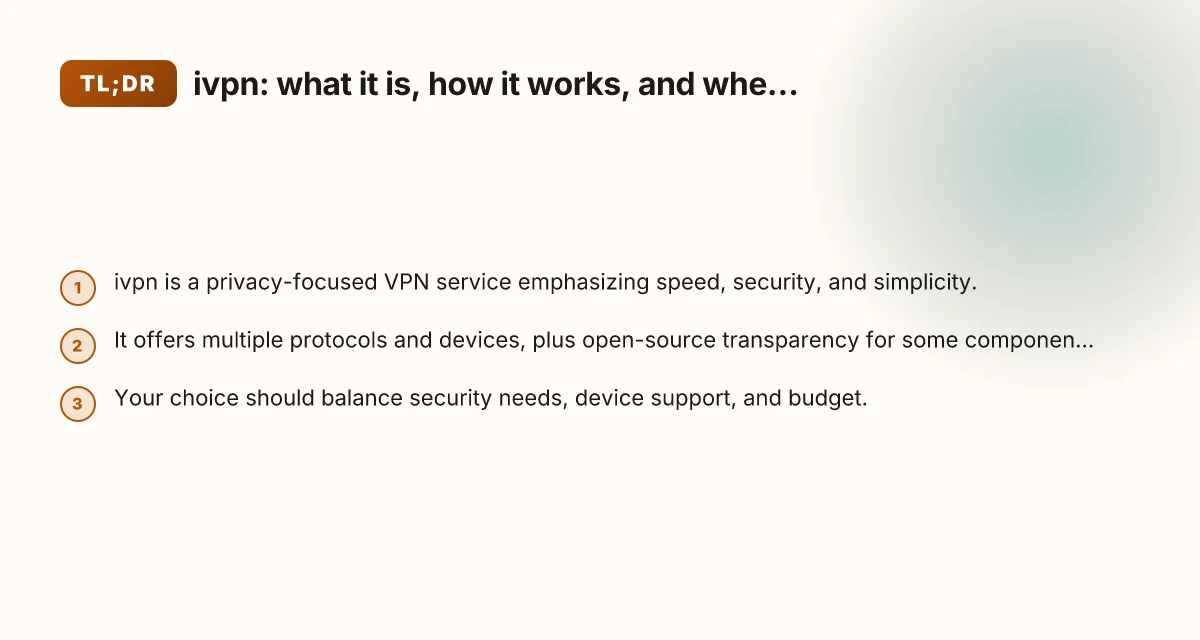
ivpn is a well-rounded VPN option for users who want solid privacy protections, flexible protocol choices, and robust device support without stepping into the most feature-rich, high-variability markets. If your top priorities are security, privacy, and reliable cross-device coverage, and you’re comfortable with a mid-range price, ivpn is a sensible choice. For bargain hunters primarily chasing the lowest price, or for users who want heavy optimizations for streaming with ultra-high-speed needs across dozens of locations, you might also compare with other providers to ensure you get the best fit for your budget and use case.
To sum up: ivpn delivers dependable security and a straightforward experience across many devices, with enough features to cover typical privacy and access needs. If that aligns with what you’re after, it’s worth trying, especially if you can take advantage of any trial period or money-back guarantee to see how it performs in your everyday environments.
| VPN | Obfuscation | From / month | Plan | Free plan | Refund | Alipay | UnionPay | Crypto | Website opens in China | Trustpilot | |
|---|---|---|---|---|---|---|---|---|---|---|---|
 ZoogVPN | Turn on manually Shadow | $2.49/mo | 27 months: $59.99 | Yes | 7 days | ✓ | ✓ | ✓ | ✓ | Official site blocked; our special link opens (4.4 s) | 4.2/5 (195 reviews) |
 NordVPN | Turn on manually Obfuscated Servers / NordWhisper | $3.49/mo | 27 months: $94.23 | No | 30 days | ? | ✗ | ✓ | ✓ | ✗ Blocked | 4.2/5 (51,628 reviews) |
 ExpressVPN | ✓ On by default all servers | $3.00/mo | 28 months: $84 | No | 30 days | ✗ | ✗ | ✓ | ✗ | ✗ Blocked | 4.4/5 (29,706 reviews) |
 Surfshark | ✓ On by default Camouflage, with OpenVPN | See site | See site | No | 30 days | ✗ | ✗ | ✗ | ✓ | ✗ Blocked | 4.3/5 (31,823 reviews) |
 Proton VPN | Turn on manually Stealth, free plan too | $2.99/mo | 12 months: $35.88 | Yes | 30 days | ✗ | ✗ | ✗ | ✓ | ✗ Blocked | 2.1/5 (1,040 reviews) |
 Astrill VPN | Turn on manually StealthVPN / OpenWeb | $12.50/mo | 24 months: $300 | No | See site | ✗ | ✗ | ✗ | ✓ | ✗ Blocked | 1.3/5 (110 reviews) |
 Private Internet Access | Turn on manually Shadowsocks, OpenVPN only | $2.03/mo | 40 months: $81.2 | No | 30 days | ✗ | ✗ | ✗ | ✗ | ✗ Blocked | 4.2/5 (11,033 reviews) |
 CyberGhost | Turn on manually selected servers | $2.19/mo | 28 months: $61.32 | No | 45 days | ✗ | ✗ | ✗ | ✓ | ✗ Blocked | 4.0/5 (24,178 reviews) |
 PureVPN | Turn on manually switch to OpenVPN | $1.69/mo | 60 months: $101.55 | No | 31 days | ? | ? | ✗ | ✓ | ✗ Blocked | 4.4/5 (17,994 reviews) |
 AdGuard VPN | ✓ On by default TrustTunnel | $2.99/mo | 24 months: $71.76 | Yes | 30 days | ✓ | ✗ | ✓ | ✓ | Official site blocked; our special link opens (3.7 s) | 4.3/5 (290 reviews) |
 Mullvad | Turn on manually QUIC / Shadowsocks / LWO | $5.61/mo | €5/mo | No | 14 days | ✗ | ✗ | ✗ | ✓ | ✗ Blocked | 3.2/5 (192 reviews) |
 Windscribe | Turn on manually Stealth / WStunnel | $5.75/mo | 12 months: $69 | Yes | See site | ✗ | ✗ | ✗ | ✓ | ✗ Blocked | 4.7/5 (13,355 reviews) |
 StrongVPN | Turn on manually Scramble, OpenVPN TCP | See site | See site | No | 30 days | ✓ | ✗ | ✗ | ✗ | ✗ Blocked | 4.4/5 (2,695 reviews) |
 LightXtreme 闪连 | Not listed | $7.08/mo | 12 months: $84.99 | Yes | 30 days | ✓ | ✓ | ✓ | ✓ | ✓ Yes (3.5 s) | No page |
Prices checked 2026-11-10 on each vendor's pricing page (cheapest long plan, USD). Check the vendor's checkout for the final price.
Obfuscation checked 2026-11-14 on each vendor's site and help center: "on by default" = nothing to set; "turn on manually" = switch protocol or mode in settings; "not listed" = the vendor describes no obfuscation.
Payment methods checked 2026-11-10 on each vendor's payment pages: all 14 take cards and PayPal; ✗ = not listed, ? = the vendor's own pages disagree.
China access: whether the official website opens from mainland China networks (tests the website only, not the VPN connection). Last checked 2026-11-18 01:02 Beijing time.
Trustpilot score and review count checked 2026-11-10.