Unfixed.ScrollToFixed: A Practical Guide to Sticky Elements in Web Design

A comprehensive guide to unfixed.ScrollToFixed, its usage, alternatives, and best practices for sticky UI elements.
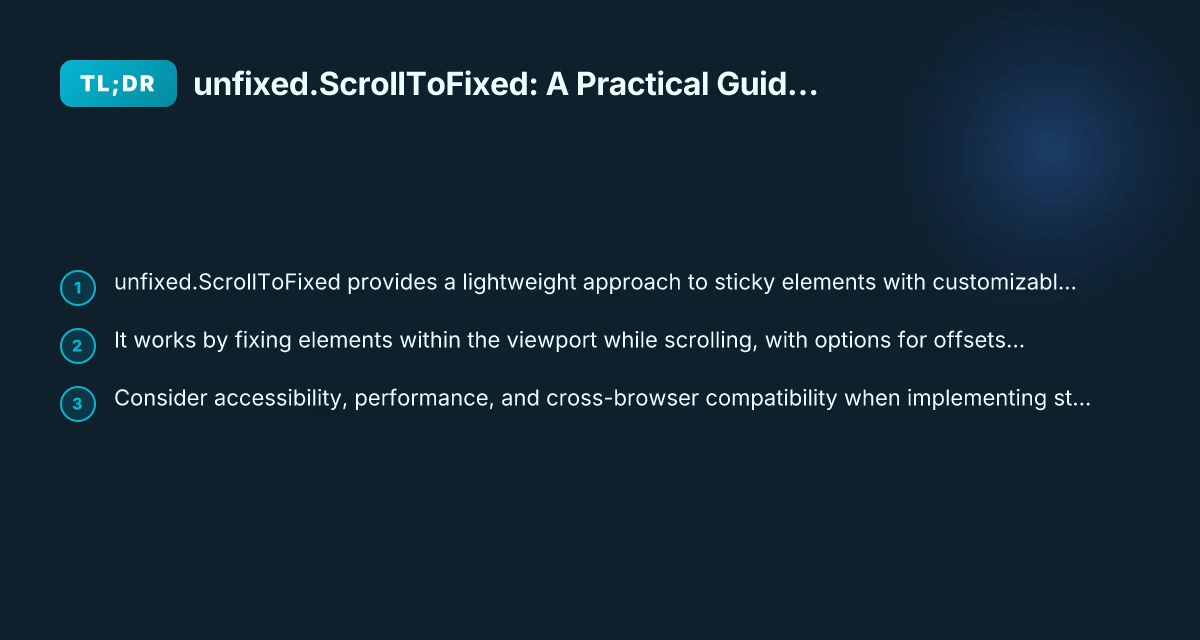
Sticky UI has become a staple of modern web design. unfixed.ScrollToFixed is one option developers explore when they want elements to stay visible as users scroll, without heavy dependencies. This article answers common questions, shows how to implement unfixed.ScrollToFixed, compares it to alternatives, and offers best practices to keep your UI smooth, accessible, and maintainable.

What is unfixed.ScrollToFixed?
unfixed.ScrollToFixed is a lightweight technique or library pattern for making an element “stick” to a position in the viewport during page scroll. Unlike fixed positioning that applies static coordinates, unfixed.ScrollToFixed often uses scroll listeners and CSS classes to toggle a fixed state, preserving layout flow when the element is not in the sticky state.
Key aspects:
- Lightweight footprint: minimal dependencies and small file size.
- Configurable offsets: allows designers to specify top or bottom offsets.
- Responsive behavior: can adapt to window resizing and device differences.
Common use cases:
- Sticky headers or call-to-action bars that appear after a user scrolls past a certain point.
- Side widgets that stay visible while the main content scrolls.
- Toolbars that become fixed for quick access during reading or form filling.
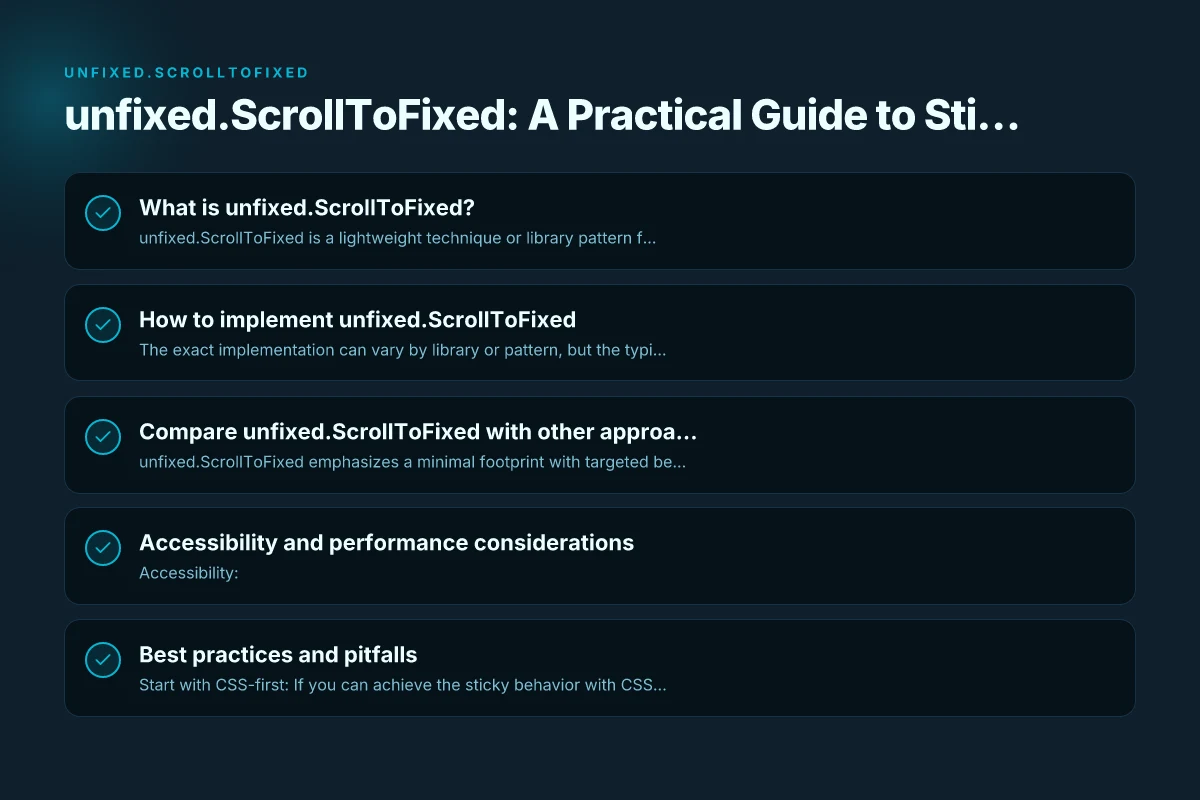
How to implement unfixed.ScrollToFixed
The exact implementation can vary by library or pattern, but the typical approach involves a few core steps. How to Submit: A Practical Guide to Submitting Forms, Applications, and Content
Step-by-step guide
- Identify the target element: Choose which element should become sticky.
- Measure the initial position: Determine the element’s offset from the top of the document.
- Listen to scroll events: Detect when the page has been scrolled past the threshold.
- Toggle fixed state: Add or remove a CSS class that switches the element’s position to fixed.
- Restore layout: Use a placeholder or margin adjustments to avoid layout shift when the element becomes fixed.
Common CSS patterns
- Non-sticky state:
- position: relative (or static) with normal flow.
- Sticky state:
- position: fixed. Top: [offset]px. Width: [same as container].
- Placeholder technique:
- A hidden or invisible spacer element that maintains page height when the sticky element becomes fixed.
Simple vanilla example
- HTML:
- Content
- (optional)
- CSS:
- #sticky { width: 100%; }
-.is-sticky { position: fixed. Top: 0. Width: 100%. Z-index: 1000; }
- JavaScript:
- const sticky = document.getElementById('sticky');
- const offset = sticky.offsetTop;
- window.addEventListener('scroll', () => { if (window.pageYOffset > offset) { sticky.classList.add('is-sticky'); } else { sticky.classList.remove('is-sticky'); } });
Responsive considerations
- Adjust top offset on resize to maintain alignment with headers or toolbars.
- Use media queries to disable or adjust sticky behavior on small screens if it harms usability.
Compare unfixed.ScrollToFixed with other approaches
| Approach | Pros | Cons | Best Use |
|---|---|---|---|
| unfixed.ScrollToFixed pattern | Lightweight, customizable, good for simple sticks | Manual maintenance, potential edge cases | Simple sticky bars or inline widgets |
| CSS position: sticky | Pure CSS, no JS, smooth behavior | Browser support is good but not universal; some edge cases with overflow | Modern layouts requiring clean, CSS-native sticky behavior |
| Fixed positioning with JavaScript | Full control over behavior, can handle complex logic | Potential layout shifts, z-index and overlapping concerns | Complex UIs needing precise control, cross-element sticking |
| Intersection Observer patterns | Efficient, declarative, scalable | Slightly more complex to install; polyfills for older browsers | Complex sticky behavior across sections |
Notes:
- unfixed.ScrollToFixed emphasizes a minimal footprint with targeted behavior. If you need heavy cross-element coordination, more robust plugins or CSS strategies might be better.
Accessibility and performance considerations
Accessibility:
- Ensure the sticky element doesn’t cover or obscure important content, especially for keyboard and screen reader users.
- Maintain logical focus order. Avoid moving focus to fixed elements unexpectedly.
- Provide an option to disable sticky behavior for users who prefer reduced motion or have motion sensitivity.
Performance: Scroll.ScrollToFixed: A Practical Guide to Sticky Elements in Web Design
- Throttle or debounce scroll handlers to reduce reflow.
- Prefer CSS transitions for any animated changes to avoid jank.
- Use a placeholder spacer to prevent layout shift, which can negatively impact perceived performance.
Cross-browser compatibility:
- Test on major browsers, including mobile Safari, Chrome for Android, and Firefox.
- Consider CSS sticky as a baseline, with a progressively enhanced unfixed.ScrollToFixed fallback for older browsers.
Best practices and pitfalls
- Start with CSS-first: If you can achieve the sticky behavior with CSS position: sticky, prefer that approach for simplicity and performance.
- Keep the sticky region narrow: Avoid large sticky areas that cover significant content, which can degrade readability.
- Don’t overuse: Having too many sticky elements can overwhelm the user and confuse navigation.
- Use clear state indicators: Visual cues should clearly show when an element is in the fixed state.
- Consider deactivation on small screens: On narrow viewports, a sticky element can cover essential content. Provide a mechanism to disable it.
When to choose unfixed.ScrollToFixed
- Your project demands a light footprint with precise control over when an element becomes fixed.
- You need custom offsets, sticky duration, or conditional stickiness that CSS alone can’t express.
- You’re extending an existing UI that already uses JavaScript-driven interactions and want to keep your codebase consistent.
When deciding, weigh the need for fine-grained behavior against the simplicity and robustness of CSS sticky features. If the only requirement is to keep a bar at the top after scrolling past a header, CSS sticky is often enough and more maintainable.
Final recommendation
If you are building a modern, responsive UI and want a straightforward solution, start with CSS position: sticky and test across devices. It provides smooth, native behavior with minimal code. If you encounter scenarios where CSS alone falls short, such as complex thresholds, cross-element coordination, or nuanced offset logic, then consider implementing unfixed.ScrollToFixed as a lightweight, option-driven addition. Always optimize for accessibility, performance, and maintainability, and remember to test across browsers and devices to ensure a consistent experience.
If you want, I can tailor a starter code snippet for your exact layout (header, sidebar, or footer) and show how to toggle sticky state with and without a placeholder, plus a small set of responsive rules. Resize.ScrollToFixed: How to Use this jQuery Plugin for Sticky Elements