Change: Understanding, Embracing, and Applying Change in Life and Work
A practical guide to understanding change, how it happens, and how to navigate it effectively.
Change is a universal force. It arrives whether we invite it or not, and our relationship with it often determines our outcomes. In this article, we’ll unpack what change is, why it happens, how it affects us, and concrete steps to navigate it with confidence. By understanding the mechanics of change and cultivating practical habits, you can turn disruption into growth.

What change is and isn’t
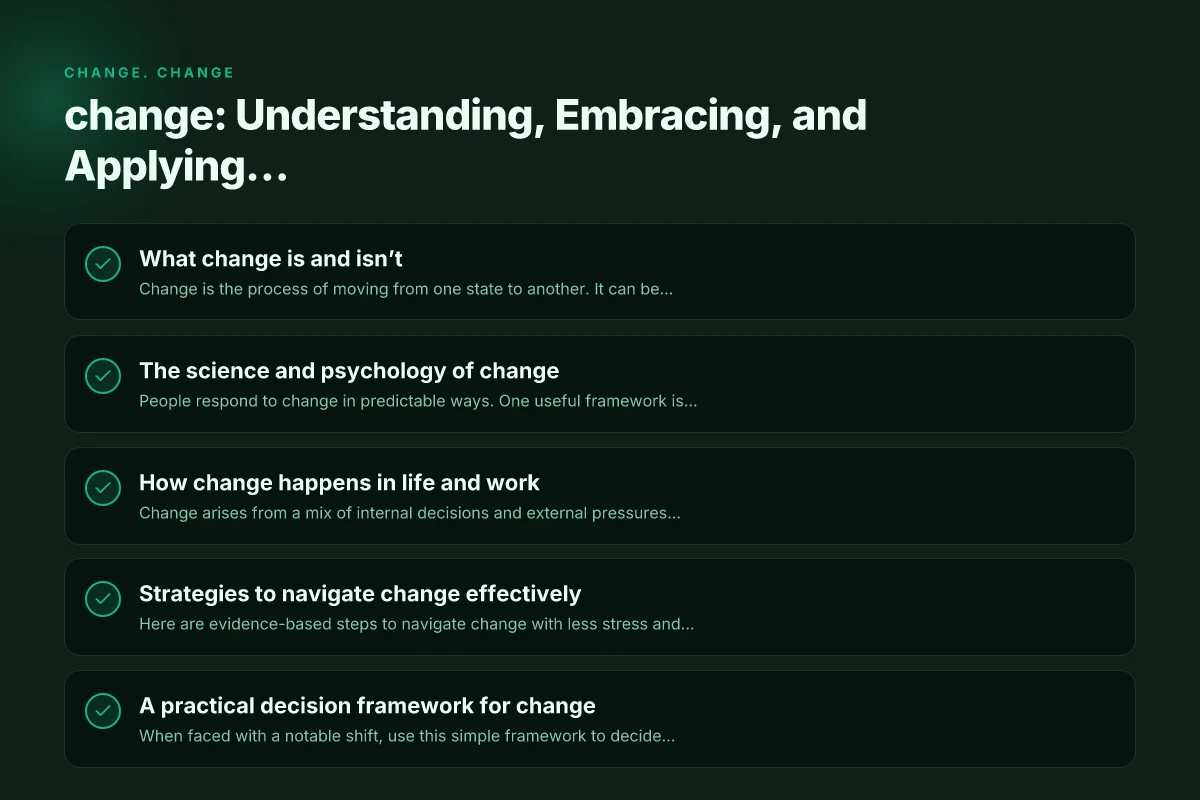
Change is the process of moving from one state to another. It can be voluntary (you decide to switch careers) or involuntary (a company restructuring). It can be planned (a project timeline shifts) or unplanned (a rapidly evolving market). Change isn’t chaos by default. It’s a transition between conditions.
Common misconceptions:
- Change means failure: Not necessarily. Change can bring new opportunities and learning.
- Change is always negative: It can be neutral or positive depending on perspective and response.
- Once change happens, you’re finished: Change often becomes the new baseline, requiring ongoing adaptation.
Understanding that change is a process, not a single event, helps you map your behavior, emotions, and decisions more effectively.
The science and psychology of change
People respond to change in predictable ways. One useful framework is the three-stage model: anticipation, adjustment, and acceptance. You may feel excitement or dread in anticipation, you work through experiments and small wins during adjustment, and you settle into a new normal in acceptance. HideMyAss: What It Is, How It Works, and Practical Privacy Considerations
Key psychological levers:
- Control: Seek what you can influence, even if it’s small.
- Clarity: Get clear information about what’s changing and why.
- Social support: Lean on colleagues, friends, or mentors who can offer perspective.
- Small wins: Break the change into manageable steps to build momentum.
Emotions are natural companions of change. Instead of fighting them, acknowledge them, label them, and decide what to do next. Acknowledgment reduces resistance and opens the door to practical action.
How change happens in life and work
Change arises from a mix of internal decisions and external pressures. In organizations, market shifts, technology, and leadership moves drive transformation. In personal life, goals, health, relationships, and environment shape change.
Trends that accelerate change: Beforeactivate: what it means and how to use it in your codebase
- Technology adoption: Faster tools alter workflows and expectations.
- Global connectivity: Information spreads quickly, changing norms and benchmarks.
- Global events: Economic cycles, policy shifts, or crises disrupt routines.
- New data: Better insights demand updates to plans and behaviors.
A practical way to view change is as a project with inputs, constraints, milestones, and outcomes. When you map it like this, you can plan more effectively and measure progress.
Strategies to navigate change effectively
Here are evidence-based steps to navigate change with less stress and more momentum:
- Reframe the narrative
- See change as an opportunity rather than a threat.
- Ask: “What could I learn? What new skills will this require?”
- Gather information
- Seek reliable sources to understand the scope and impact.
- Avoid overload by identifying the top three facts you need to proceed.
- Define a flexible plan
- Set a clear goal aligned with your values.
- Build a plan with options and contingencies, not a single rigid path.
- Build adaptive routines
- Create repeatable processes that reduce decision fatigue.
- Examples: weekly check-ins, daily reflection, and quick review cycles.
- Develop new skills
- Identify skill gaps the change reveals.
- Prioritize learning through micro-learning, practice, and feedback loops.
- Fortify your support network
- Reach out to mentors, peers, or professional coaches.
- Share your plan to increase accountability and receive input.
- Experiment and iterate
- Test small changes, measure results, and adjust.
- Treat failures as data, not verdicts.
- Protect well-being
- Sleep, nutrition, and exercise improve cognitive flexibility.
- Schedule downtime to avoid burnout during transitions.
A practical decision framework for change
When faced with a notable shift, use this simple framework to decide your next moves:
- What is changing? Define the scope and impact.
- Why is this change happening? Understand the drivers and outcomes.
- What can I control? List levers you can influence.
- What are the options? Brainstorm at least three paths.
- What are the trade-offs? Consider time, cost, and risk.
- What will success look like? Define measurable outcomes.
- What is the first step? Commit to a concrete action within 24 hours.
Below is a quick comparison to help visualize approaches to change in common scenarios. Hide me
| Scenario | Proactive Change (Plan) | Reactive Change (Respond) |
|---|---|---|
| Career | Identify target roles, upskill, network | Wait for a job opening, react to postings |
| Technology | Evaluate tools, pilot, scale | Implement as needed to fix failures |
| Personal life | Set goals, establish routines | Address symptoms after issues arise |
| Organization | Strategic initiative, change champions | Handle crises as they emerge |
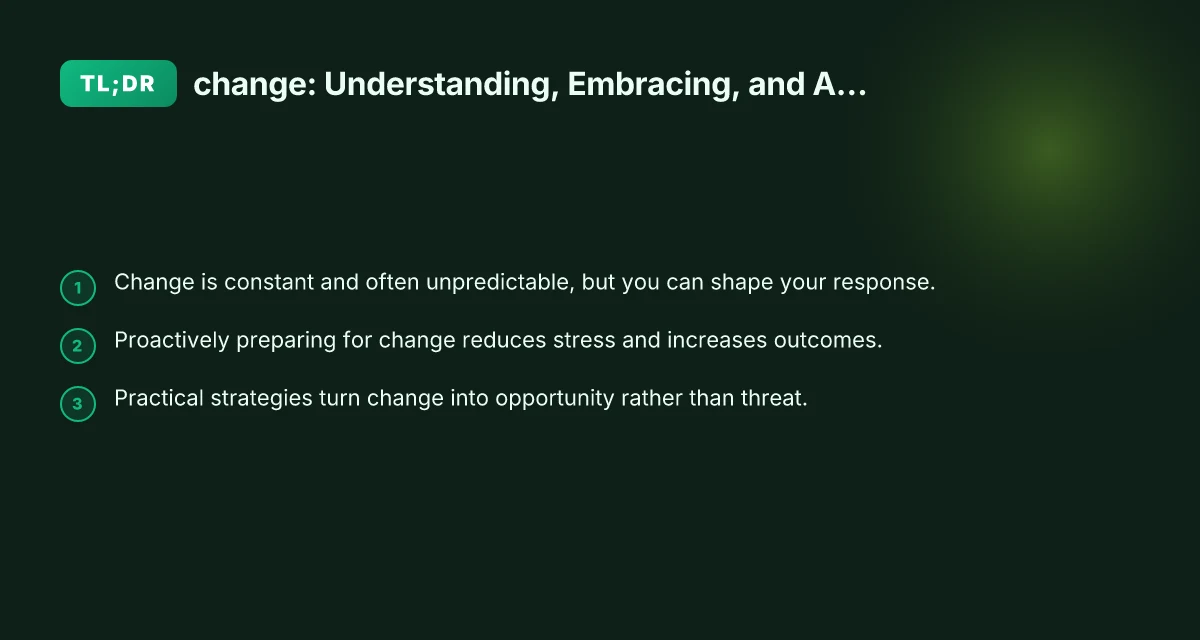
Proactive change tends to yield smoother transitions, more control, and better alignment with long-term goals. Reactive change can be efficient in urgent situations, but it often requires rapid adjustment and may carry higher risk of misalignment.
Common change scenarios and how to handle them
- Career transitions: Map your desired path, acquire relevant certifications, and build a portfolio. Networking accelerates opportunity.
- Organizational restructuring: Seek leadership communication, understand new roles, and document responsibilities. Clarify expectations with your team.
- Technology shifts: Start with a minimal viable implementation, test with a small group, and scale based on feedback.
- Life milestones: Break big milestones into achievable steps, involve trusted people, and celebrate progress.
In each scenario, the themes are constant: clarity, capability, support, and iteration.
The role of mindset in change
Your mindset shapes how you experience change. A growth mindset, believing abilities can be developed, drives experimentation and resilience. A fixed mindset, believing abilities are static, can hinder learning during transitions.
Ways to cultivate a growth mindset during change: Hide IP VPN: How to Protect Your Privacy Online
- Reframe challenges as learning opportunities.
- Seek feedback and apply it.
- Embrace deliberate practice with clear, incremental targets.
- Separate you from the outcome: outcomes are influenced by many factors, but your process matters.
Habits to reinforce a resilient mindset:
- Daily reflection: What did I learn today? What will I try tomorrow?
- Journaling: Track emotions and responses to changes.
- Rituals: Short, consistent routines that anchor your day amid upheaval.
A short, actionable plan you can start today
- List the change you’re facing and your initial reaction.
- Identify three controllable factors and three external factors.
- Choose one small, doable action that moves you toward a preferred outcome.
- Schedule a 15-minute check-in for the next three days to monitor progress.
- Reach out to one person for perspective or mentorship.
This simple plan reduces overwhelm and creates tangible momentum, which is often the hardest part of change.
Final recommendation
Change is not a problem to be solved but a process to be managed. By understanding the mechanics of change, preparing proactively, and applying a consistent set of practical strategies, you can navigate disruptions with confidence. Embrace curiosity over fear, lean on your support network, and treat change as an ongoing, manageable cycle rather than a one-off event. With the right mindset and tools, change becomes a driver of growth, not a barrier to progress.