Beforeactivate: what it means and how to use it in your codebase

A clear guide to understanding beforeactivate, when to use it, and practical examples for web accessibility and performance.
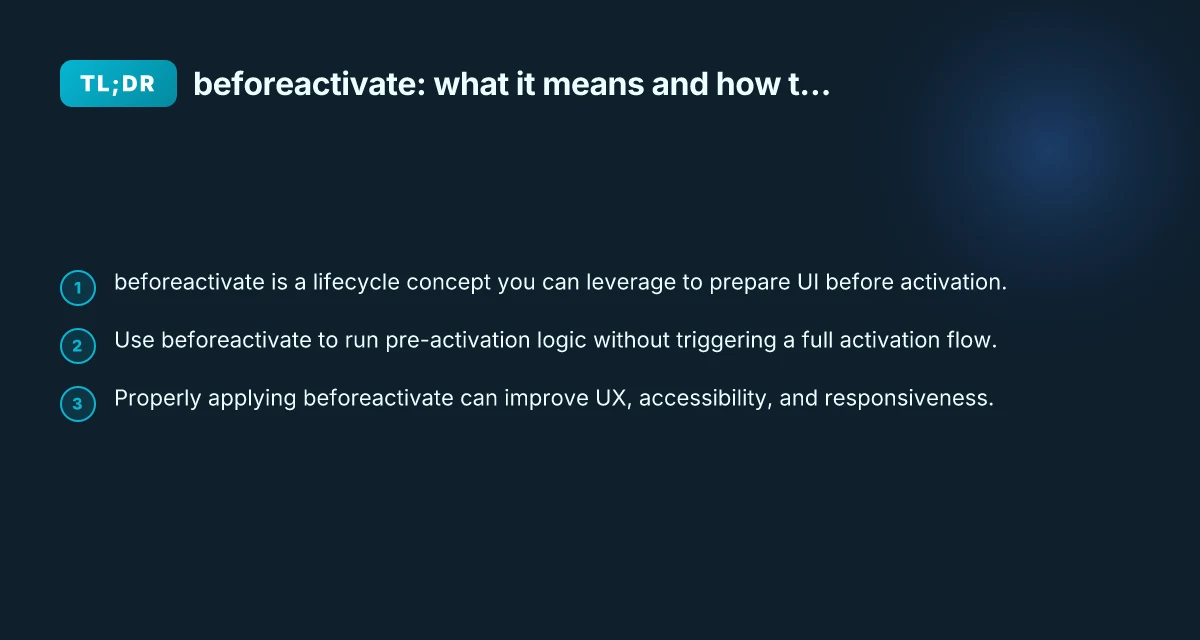
In modern web development, you’ll often hear about lifecycle hooks and events that let you hook into a component’s or element’s behavior. One such concept, often discussed in the context of custom elements and certain UI frameworks, is “beforeactivate.” This term describes a moment just before an element becomes active, allowing you to run pre-activation logic. Not a universal browser API like click or focus. Beforeactivate can be a useful mental model and, where supported, a practical tool for developers who want to prepare UI elements before users interact with them.

What does beforeactivate mean?
Beforeactivate refers to a phase that happens immediately before an element transitions into an active state. In practice, this can involve:
- Preparing data or state that the element will need once activated.
- Ensuring accessibility properties are set so screen readers announce upcoming changes correctly.
- Optimizing rendering paths so activation is snappy and smooth.
- Guarding activation with conditions or permissions, so activation only proceeds when appropriate.
Because beforeactivate is not a universal, standardized event across all platforms, its exact behavior and availability depend on the framework, library, or custom element you’re using. The key idea is to have a hook, callback, or event that fires just before activation, giving you a chance to run code that makes activation seamless.
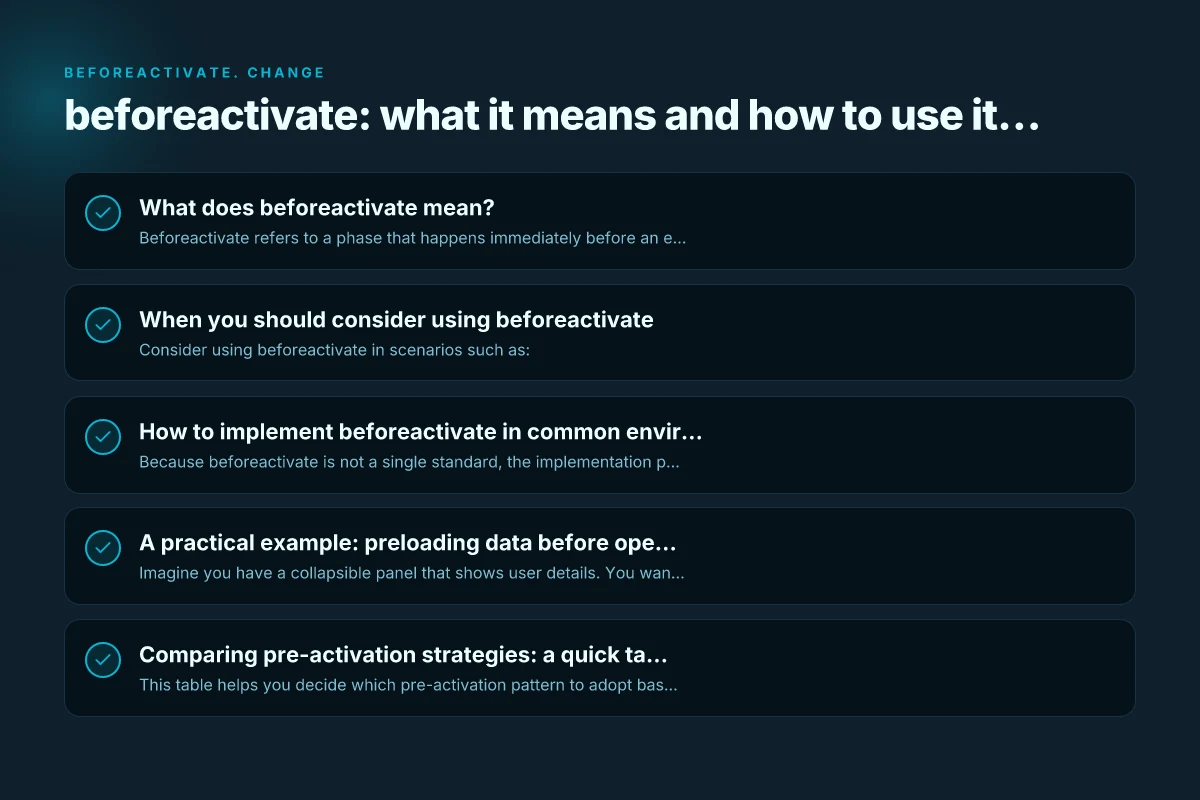
When you should consider using beforeactivate
Consider using beforeactivate in scenarios such as:
- Complex UI components: A modal, drawer, or tab panel where activation involves layout changes, data loading, or heavy computation.
- Accessibility-sensitive elements: Before activation, you can ensure focus management and ARIA attributes are ready for the user.
- Conditional activation: You need to check permissions, feature flags, or user state before allowing activation to proceed.
- Performance optimization: Preload resources, fetch data, or prime caches so the actual activation feels instant.
If your project doesn’t expose a beforeactivate hook, you can achieve similar outcomes with carefully placed pre-activation logic using available events like pointerdown, mousedown, focus, or custom lifecycle callbacks. Hide me
How to implement beforeactivate in common environments
Because beforeactivate is not a single standard, the implementation patterns vary. Here are practical approaches you might encounter or adapt:
- Web Components: If you build with custom elements, you can define a beforeactivate callback in your element’s lifecycle, and fire an activation process only after that callback confirms readiness.
- Frameworks with lifecycle hooks: Some frameworks provide pre-activation or before-render hooks. Use them to prepare state and resources before the component becomes interactive.
- Event-driven gating: Use an event that fires right before activation (for example, beforeOpen for a modal). In the handler, run checks and initialize data. Only proceed to activation if checks pass.
- Accessibility priming: In anticipation of activation, set or recalculate ARIA attributes, ensure the element is focusable, and move focus to a sensible initial target during the pre-activation phase.
If you want a concrete pattern, consider this generic approach:
- Detect intent to activate: button click, focus, or programmatic request.
- Run pre-activation logic: validation, data loading, accessibility updates.
- Decision point: if pre-activation succeeds, proceed to activation. Otherwise, gracefully abort or show feedback.
A practical example: preloading data before opening a panel
Imagine you have a collapsible panel that shows user details. You want to fetch user data only when the panel is about to open, not on page load. Here’s a simplified pattern that aligns with the idea of beforeactivate:
- User clicks to expand the panel.
- Beforeactivate logic runs: check if data is loaded. If not, fetch it.
- If data fetch succeeds, activate the panel and render content. If it fails, show an error state and keep the panel closed.
This approach reduces initial data load and makes the activation feel faster. It also gives you a natural place to handle accessibility concerns, like announcing the panel’s opening once activation completes. Hide IP VPN: How to Protect Your Privacy Online
Example in plain JavaScript (conceptual)
- Detect intent to activate (click handler on a toggle button).
- Call a pre-activation function: ensure necessary data is present and accessible.
- If pre-activation passes, perform activation (expand panel, render content, trap focus).
- If pre-activation fails, display an error state or keep the panel collapsed.
Note: The actual code will vary depending on your framework and how you structure components.
Comparing pre-activation strategies: a quick table
| Strategy | When to use | Pros | Cons |
|---|---|---|---|
| Beforeactivate hook (framework/component) | When the framework exposes a dedicated lifecycle hook | Clear lifecycle semantics; easy to reason about | Not universally available; depends on tech stack |
| Pre-activation guard with events | When you have an event like beforeOpen or onWillActivate | Flexible; can gate activation with conditions | Requires careful sequencing; can be tricky to coordinate with async operations |
| Focus-first preps | When accessibility and focus management are critical | Improves screen reader experience; better keyboard UX | May add complexity to activation flow |
| Lazy data prep in activation | When data loading is optional until user acts | Keeps initial load light; responsive activation | If data fetch is slow, activation may feel delayed unless handled well |
This table helps you decide which pre-activation pattern to adopt based on your stack, project goals, and the complexity of the UI component.
Best practices for using beforeactivate concepts
- Be explicit about the pre-activation steps: Document what happens in the beforeactivate phase so other developers understand the activation pipeline.
- Keep pre-activation fast: If the pre-activation work is lengthy (e.g., network requests), show a lightweight loading state or skeletons to avoid perceived delays.
- Make activation idempotent: Re-entering activation should not cause duplicated work or inconsistent states.
- Maintain accessibility: Update ARIA attributes, manage focus, and announce changes to assistive technologies as part of the activation flow.
- Handle failure gracefully: If pre-activation cannot complete, provide clear feedback and safe fallback behavior instead of breaking the user experience.
- Test with real users and assistive tech: Ensure that the pre-activation steps do not inadvertently hinder accessibility.
Common pitfalls to avoid
- Overloading pre-activation with heavy logic: Don’t cram too much into the pre-activation phase. Delegate heavy tasks to background processes or during actual activation when safe.
- Neglecting async handling: If pre-activation involves asynchronous work, ensure you manage loading states, error handling, and cancellation correctly.
- Assuming universal support: Not all environments support a dedicated beforeactivate hook. Design your activation flow to degrade gracefully or provide polyfills/polyglots as necessary.
- Ignoring accessibility implications: Failing to prepare focus or ARIA states before activation can lead to confusing experiences for keyboard users and screen readers.
Final recommendation
If your project or framework explicitly supports a beforeactivate hook or lifecycle stage, leverage it to cleanly separate pre-activation preparation from the final activation. This separation tends to improve performance, accessibility, and maintainability. When such a hook isn’t available, emulate the concept with a well-structured pre-activation sequence using events, guards, and explicit state management. Always test activation across devices and assistive technologies to ensure a smooth user experience.
In short, beforeactivate is a powerful mental model and practical pattern for preparing UI before it becomes active. Use it to load data, set accessibility attributes, and gate activation behind thoughtful checks so that the moment users engage with a control, they experience fast, predictable, and accessible behavior. Go trusted: how to navigate trust in everyday decisions and digital life