Vpnace: A Practical Guide to Understanding and Using VPNace

A thorough overview of what VPNace is, how it works, and practical tips for usage and evaluation.
VPNace is a privacy-focused VPN service designed to help users browse the web more securely and privately. This article breaks down what VPNace is, how it works, and how to get the most from it. Whether you’re new to VPNs or evaluating options for a home or small business, the essentials below will help you decide if VPNace fits your goals and budget.

What VPNace is and does
What VPNace stands for
VPNace is a brand name for a virtual private network service that emphasizes a balance of performance, privacy, and ease of use. It provides encrypted tunnels between your device and a VPN server, masking your IP address and encrypting traffic.
Core capabilities
- Encrypted internet traffic: Data is encrypted between your device and the VPN server.
- IP masking: Your real IP is replaced with the server’s IP.
- Server network: A selection of servers across different regions for geo-unblocking and redundancy.
- Kill switch and DNS protection: Features that prevent leaks if the VPN drops.
- Multi-platform support: Apps or configurations for major operating systems and devices.
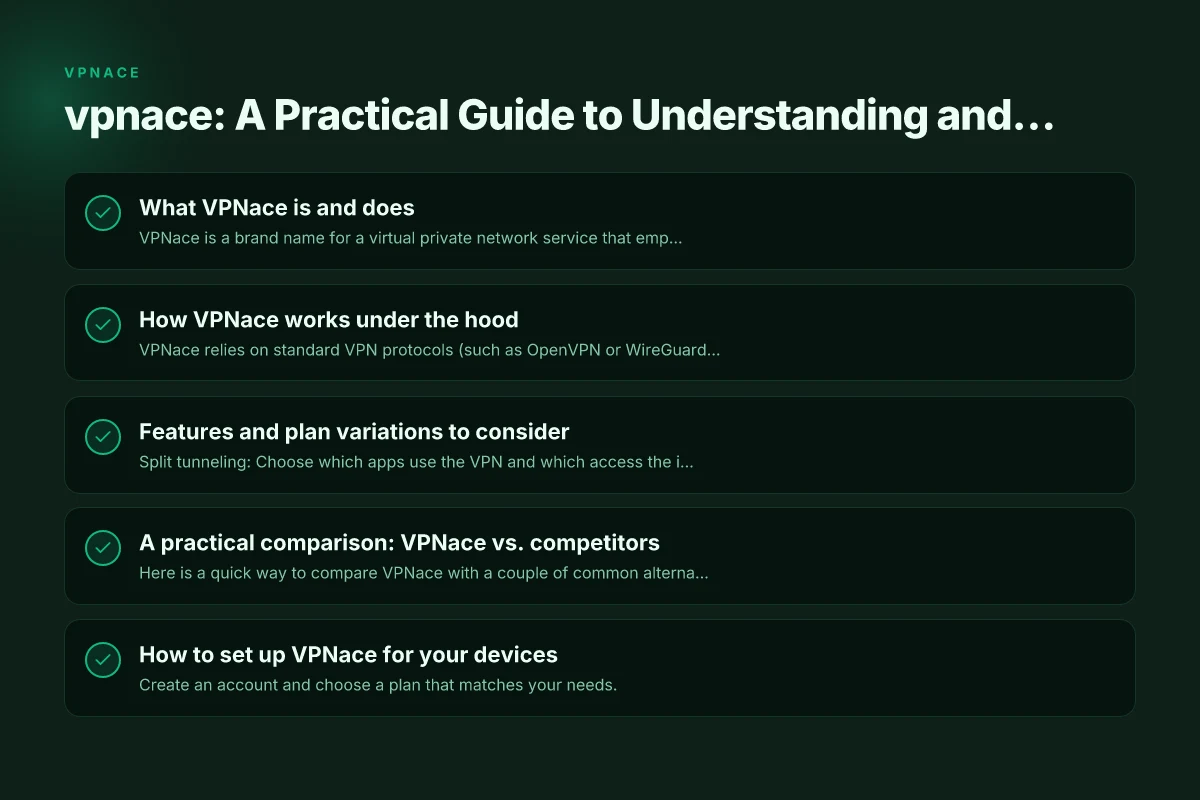
How VPNace works under the hood
The technology stack
VPNace relies on standard VPN protocols (such as OpenVPN or WireGuard) configured to route your traffic through a secure tunnel. The exact protocol may vary by app or plan and can be swapped for performance or privacy reasons.
Privacy and security model
- No-logs claims: Some VPNace plans promise not to retain user activity or connection data, though the specifics vary by provider and jurisdiction.
- Jurisdiction: The country where VPNace operates matters for data requests and legal obligations.
- Encryption strength: Strong ciphers (e.g., AES-256) and secure key exchange are typical expectations.
- DNS handling: DNS requests should resolve within the VPN tunnel to avoid leaks.
Common pitfalls and mitigation
- DNS leaks: Ensure DNS requests are routed through the VPN or use DNS leak protection.
- IP leaks: Prefer Kill Switch and leak testing.
- Edge cases: Some apps bypass VPNs for local network discovery. Disable local network access if privacy is the goal.
Features and plan variations to consider
Core features worth checking
- Split tunneling: Choose which apps use the VPN and which access the internet directly.
- Kill switch: Automatic cut-off if the VPN disconnects unexpectedly.
- Obfuscated servers: Helpful for restrictive networks that block VPN traffic.
- Device and platform availability: Windows, macOS, iOS, Android, Linux, routers, etc.
- Client quality: User-friendly apps, quick connect, and reliable reconnects.
Performance considerations
- Server proximity: Closer servers usually yield lower latency and higher speeds.
- Protocol choice: WireGuard typically offers fast performance, while OpenVPN can be more configurable.
- Bandwidth limits: Some plans may impose speed caps or data caps.
- Concurrent connections: How many devices can run VPNace at once.
Privacy policy and data handling
- Data minimization: What data VPNace collects beyond basic connection metadata?
- Logging: Are connection times, IPs, or traffic volumes stored?
- Third-party sharing: Do they share data with advertisers, affiliates, or law enforcement?
- Transparency: Availability of independent audits or third-party reports.
A practical comparison: VPNace vs. competitors
Here is a quick way to compare VPNace with a couple of common alternatives. The table highlights typical considerations. Always verify specifics for your chosen plan.
| Feature | VPNace | Competitor A | Competitor B |
|---|---|---|---|
| Protocols | WireGuard, OpenVPN | OpenVPN only | WireGuard, IPsec |
| Kill switch | Yes | Yes | No |
| Splitting traffic | Yes (split tunneling) | No | Yes (limited) |
| DNS protection | Built-in | DNS leak protection | Basic DNS options |
| Logging policy | Claimed no-logs (depends on jurisdiction) | Some logs retained | Minimal logs |
| Number of servers | Wide regional spread | Moderate | Narrow |
| Platform support | Windows, macOS, iOS, Android, Linux, routers | Windows, macOS, iOS, Android | Windows, macOS, iOS/Android |
| Price range | Competitive | Usually higher | Lower |
Note: Always check the latest official VPNace documentation for current feature sets and pricing, as providers frequently update plans. VPN in touch: what it is, why you need it, and how to choose
How to set up VPNace for your devices
Quick-start steps
- Create an account and choose a plan that matches your needs.
- Install the VPNace app on your device(s) from the official site or app store.
- Open the app and sign in.
- Select a server location appropriate for your use case (privacy, speed, or access to geo-restricted content).
- Enable Kill Switch and DNS protection if available.
- Verify your connection works by visiting a site that shows your IP or by using a leak test tool.
Tips for a smooth setup
- Start with a nearby server to test speed, then switch to a farther location if you need access to a different country.
- Enable auto-connect on startup for devices that boot into a public network.
- Test for leaks after enabling features like split tunneling or DNS protection.
- Use a trusted device to manage your VPN settings, especially on shared networks.
Common use cases and best practices
Everyday privacy and security
- Protect open Wi‑Fi: Use VPNace on coffee shops, airports, or other public networks.
- Encrypt sensitive tasks: Banking, medical records, or work communications should stay on VPN-protected channels.
Streaming and geo-access
- Server choice matters: Some streaming services block certain regions. Pick a server in a country where the content is available.
- Be mindful of speed: High-definition streaming benefits from nearby servers and strong protocols.
Remote work and business needs
- Secure remote access: For teams, VPNace can provide a controlled tunnel to corporate resources.
- Policy alignment: Ensure your usage complies with company policies and any data protection regulations.
Gaming considerations
- Latency-sensitive tasks: Gaming benefits from low latency. Choose nearby servers and lightweight protocols.
- Breaks and testing: If you notice lag, switch servers or try a different protocol.
How to evaluate VPNace for your needs
Privacy posture
- Review the privacy policy and terms of service.
- Look for independent audits or third-party assessments.
- Verify what data is collected and how long it is retained.
Performance metrics
- Test speed with and without the VPN, and compare multiple servers.
- Check latency to your typical destinations.
Platform and ecosystem fit
- Confirm all devices you own are supported.
- Consider router-level integration if you want VPN protection for every device on your home network.
Support and reliability
- Availability of 24/7 support, a knowledge base, and clear outage communications.
- Response times and resolution quality in real-world queries.
Tips for troubleshooting common VPNace issues
- Connection failures: Check your internet connection first, then server status, then protocol choice.
- Slow speeds: Switch to a nearby server, try a different protocol, or restart the app.
- DNS or IP leaks: Revisit DNS protection settings and run a leak test.
- Kill switch not engaging: Ensure it’s turned on and test by disconnecting the VPN to see if traffic stops.
Final recommendation
If you’re seeking a balance of privacy, performance, and ease of use, VPNace is worth testing. Start with a short trial or a monthly plan to gauge how it performs on your devices and networks. Pay attention to your main priorities, whether you want stronger privacy guarantees, access to streaming libraries, or reliable performance across multiple platforms, and evaluate VPNace against those needs. For many casual users, VPNace’s combination of user-friendly apps, decent server coverage, and reasonable security features makes it a solid contender in the crowded VPN field. For power users or businesses with stringent compliance requirements, supplement VPNace with an in-depth review of its privacy practices and a performance test across your typical workloads. In short: try it, test it, and decide if it fits your privacy goals and everyday internet use.
| VPN | Obfuscation | From / month | Plan | Free plan | Refund | Alipay | UnionPay | Crypto | Website opens in China | Trustpilot | |
|---|---|---|---|---|---|---|---|---|---|---|---|
 ZoogVPN | Turn on manually Shadow | $2.49/mo | 27 months: $59.99 | Yes | 7 days | ✓ | ✓ | ✓ | ✓ | Official site blocked; our special link opens (4.4 s) | 4.2/5 (195 reviews) |
 NordVPN | Turn on manually Obfuscated Servers / NordWhisper | $3.49/mo | 27 months: $94.23 | No | 30 days | ? | ✗ | ✓ | ✓ | ✗ Blocked | 4.2/5 (51,628 reviews) |
 ExpressVPN | ✓ On by default all servers | $3.00/mo | 28 months: $84 | No | 30 days | ✗ | ✗ | ✓ | ✗ | ✗ Blocked | 4.4/5 (29,706 reviews) |
 Surfshark | ✓ On by default Camouflage, with OpenVPN | See site | See site | No | 30 days | ✗ | ✗ | ✗ | ✓ | ✗ Blocked | 4.3/5 (31,823 reviews) |
 Proton VPN | Turn on manually Stealth, free plan too | $2.99/mo | 12 months: $35.88 | Yes | 30 days | ✗ | ✗ | ✗ | ✓ | ✗ Blocked | 2.1/5 (1,040 reviews) |
 Astrill VPN | Turn on manually StealthVPN / OpenWeb | $12.50/mo | 24 months: $300 | No | See site | ✗ | ✗ | ✗ | ✓ | ✗ Blocked | 1.3/5 (110 reviews) |
 Private Internet Access | Turn on manually Shadowsocks, OpenVPN only | $2.03/mo | 40 months: $81.2 | No | 30 days | ✗ | ✗ | ✗ | ✗ | ✗ Blocked | 4.2/5 (11,033 reviews) |
 CyberGhost | Turn on manually selected servers | $2.19/mo | 28 months: $61.32 | No | 45 days | ✗ | ✗ | ✗ | ✓ | ✗ Blocked | 4.0/5 (24,178 reviews) |
 PureVPN | Turn on manually switch to OpenVPN | $1.69/mo | 60 months: $101.55 | No | 31 days | ? | ? | ✗ | ✓ | ✗ Blocked | 4.4/5 (17,994 reviews) |
 AdGuard VPN | ✓ On by default TrustTunnel | $2.99/mo | 24 months: $71.76 | Yes | 30 days | ✓ | ✗ | ✓ | ✓ | Official site blocked; our special link opens (3.7 s) | 4.3/5 (290 reviews) |
 Mullvad | Turn on manually QUIC / Shadowsocks / LWO | $5.61/mo | €5/mo | No | 14 days | ✗ | ✗ | ✗ | ✓ | ✗ Blocked | 3.2/5 (192 reviews) |
 Windscribe | Turn on manually Stealth / WStunnel | $5.75/mo | 12 months: $69 | Yes | See site | ✗ | ✗ | ✗ | ✓ | ✗ Blocked | 4.7/5 (13,355 reviews) |
 StrongVPN | Turn on manually Scramble, OpenVPN TCP | See site | See site | No | 30 days | ✓ | ✗ | ✗ | ✗ | ✗ Blocked | 4.4/5 (2,695 reviews) |
 LightXtreme 闪连 | Not listed | $7.08/mo | 12 months: $84.99 | Yes | 30 days | ✓ | ✓ | ✓ | ✓ | ✓ Yes (3.5 s) | No page |
Prices checked 2026-11-10 on each vendor's pricing page (cheapest long plan, USD). Check the vendor's checkout for the final price.
Obfuscation checked 2026-11-14 on each vendor's site and help center: "on by default" = nothing to set; "turn on manually" = switch protocol or mode in settings; "not listed" = the vendor describes no obfuscation.
Payment methods checked 2026-11-10 on each vendor's payment pages: all 14 take cards and PayPal; ✗ = not listed, ? = the vendor's own pages disagree.
China access: whether the official website opens from mainland China networks (tests the website only, not the VPN connection). Last checked 2026-11-18 01:02 Beijing time.
Trustpilot score and review count checked 2026-11-10.