VPN in touch: what it is, why you need it, and how to choose

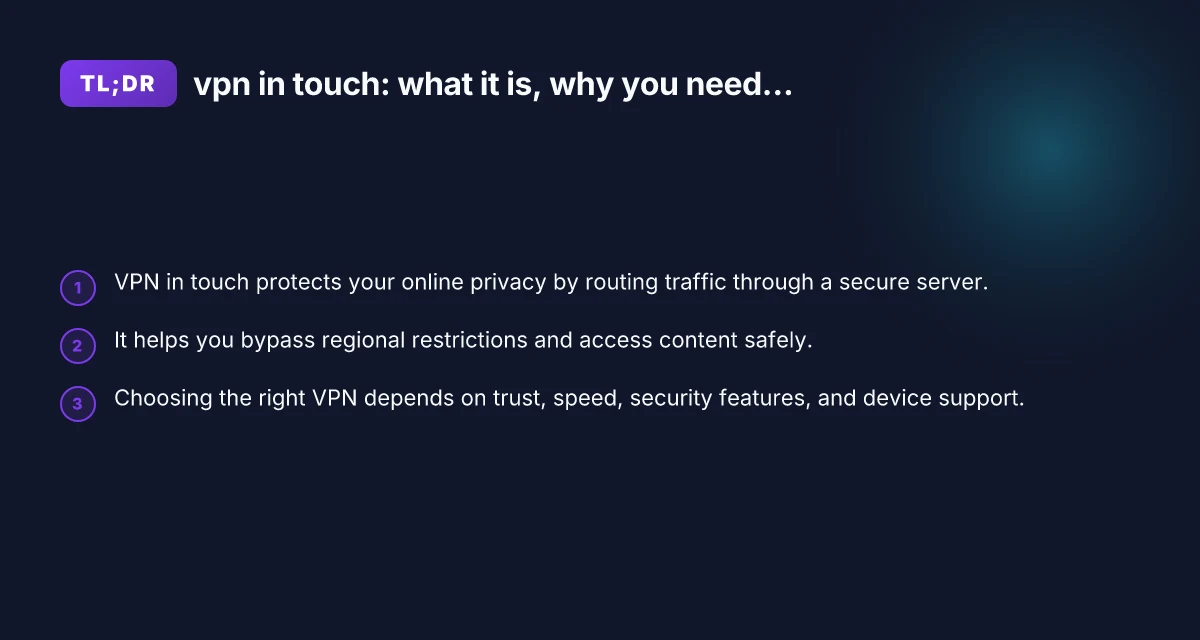
A clear guide to using VPN in touch, including what it is, how it works, and tips to pick the right service.
In today’s connected world, VPN in touch is more than a buzzword. It’s a practical approach to safeguarding your online activity, especially when you’re on public Wi‑Fi, traveling, or simply trying to keep your data private. This guide explains what a VPN in touch means, how it works, and how to pick the right service for your needs.

What does “VPN in touch” mean?
A VPN, or virtual private network, creates a secure, encrypted tunnel between your device and a VPN server. When you hear “VPN in touch,” it generally refers to using a VPN in real time across devices and networks to maintain privacy and access. Key concepts include:
- Encryption: Your data is scrambled so others can’t read it.
- Tunneling: Your internet traffic is routed through a VPN server.
- IP masking: Your real IP address is replaced with the server’s IP.
- Privacy vs. legality: A VPN protects privacy, but you should still follow local laws.
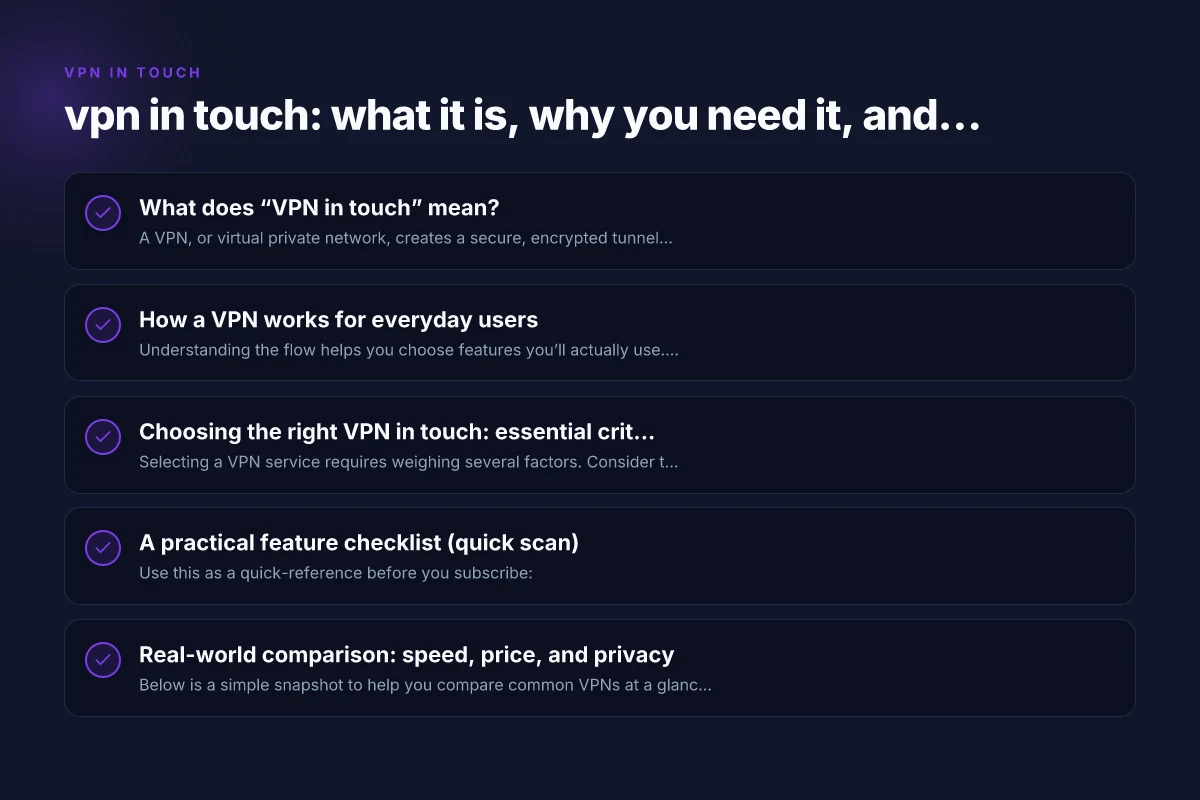
How a VPN works for everyday users
Understanding the flow helps you choose features you’ll actually use. Here’s what happens when you enable a VPN:
- Your device connects to a VPN server.
- Data is encrypted before it leaves your device.
- The VPN server forwards your traffic to the destination (website, app, etc.).
- The responses travel back through the VPN server and are decrypted on your device.
- Your apparent location appears as the VPN server’s location.
Common use cases:
- Public Wi‑Fi safety: Reduces risk on coffee shop or airport networks.
- Geo‑unblocking: Access content available in other regions.
- Privacy protection: Hide browsing patterns from ISPs and advertisers.
- Remote work: Secure access to company resources.
Choosing the right VPN in touch: essential criteria
Selecting a VPN service requires weighing several factors. Consider these in your decision: VPN ac: Understanding and Choosing the Right VPN for Air Conditioning (and Everyday Privacy)
- Security and privacy policies
- Encryption standards (e.g., AES-256)
- No-logs commitments
- Open source protocols or independent audits
- Speed and performance
- Server network size and distribution
- Protocols offered (OpenVPN, WireGuard, IKEv2)
- Bandwidth and latency impact
- Device and platform coverage
- Support for Windows, macOS, iOS, Android, Linux
- Browser extensions and router compatibility
- Features you’ll actually use
- Kill switch, DNS leak protection
- Split tunneling
- Multi-hop routing in some cases
- Pricing and value
- Free trials or money-back guarantees
- Long-term pricing vs. monthly
- Trust and transparency
- Company location and data retention laws
- Independent audits and transparency reports
A practical feature checklist (quick scan)
Use this as a quick-reference before you subscribe:
- Encryption: AES-256 or better
- Protocols supported: WireGuard and at least one traditional option
- No-logs policy: clear, verifiable
- Kill switch: on by default
- DNS and WebRTC leak protection: enabled
- Split tunneling: available (helps you control what goes through VPN)
- Device limit: appropriate for your household or travel needs
- Customer support: 24/7 access and clear SLA
- Jurisdiction: favorable privacy laws (e.g., not in a mass-surveillance friendly country)
- Independent audits: recent and public
Real-world comparison: speed, price, and privacy
Below is a simple snapshot to help you compare common VPNs at a glance. Note that actual speeds vary by location and server load.
| VPN in touch feature | Good for | Typical price (monthly) | Notable caveats |
|---|---|---|---|
| Strong encryption + WireGuard | Daily privacy, streaming in regions | $6–12 | Some servers occasionally slow during peak times |
| Large server network + split tunneling | Travel, geo-relief, business users | $8–15 | Billing and renewal terms vary by vendor |
| Focus on no-logs + audits | Privacy purists, researchers | $10–20 | Some features may be behind higher tiers |
| Budget option with essential features | Beginners, casual browsing | $2–6 | Fewer servers, limited advanced options |
When evaluating a service, try a trial or money-back period to test:
- Speed on typical servers you’ll use
- Real-world compatibility with your devices
- Effectiveness of the kill switch and DNS protection
- Ability to access the content you need
How to use VPN in touch safely and effectively
Getting the most from a VPN means using it thoughtfully. Here are best practices: TorGuard VPN review: is TorGuard VPN the right choice for private browsing and torrenting?
- Turn it on on public networks: Always connect when you’re on coffee shops, airports, or hotels.
- Select a nearby server for speed: Proximity generally improves latency.
- Use split tunneling for efficiency: Route only sensitive apps through the VPN if you don’t need full traffic to be protected.
- Keep a clean device: Regular updates, firewall enabled, and trusted apps only.
- Be mindful of policy boundaries: Respect local laws and terms of service for streaming platforms.
- Test for leaks: Periodically check for IP, DNS, and WebRTC leaks.
- Save the meaningful data for later: If you’re using login credentials, prefer devices with stronger security controls and MFA.
Common pitfalls and how to avoid them
- Overtrusting a new vendor: Do due diligence, read audits, and search for independent reviews.
- Neglecting updates: If you skip updates, you may miss important security fixes.
- Misconfiguring features: Split tunneling is powerful but can leak if misused.
- Assuming a free VPN is risk-free: Free services often monetize data or inject ads. They can be less trustworthy.
Final section: recommendation
If you’re new to VPN in touch, start with a reputable provider known for strong privacy credentials, transparent policy, and a robust, multilingual support system. Look for a service with:
- A clear, verifiable no-logs policy
- Modern protocols (WireGuard as a default, plus OpenVPN/IKEv2)
- A broad server network near your location
- A kill switch and DNS leak protection enabled by default
- A straightforward refund policy and a free trial period
For most everyday users, a balance of privacy, speed, and value is the sweet spot. Pick a plan that fits your budget, but don’t compromise on security features. If you travel a lot or rely on public networks, invest in a service that consistently performs well across multiple regions and devices.
In short, vpn in touch is about more than concealing your activity. It’s about regaining control over your digital footprint while keeping your connections fast and reliable. Start with a reputable option, test it thoroughly, and tailor it to how you work, travel, and stream.
| VPN | Obfuscation | From / month | Plan | Free plan | Refund | Alipay | UnionPay | Crypto | Website opens in China | Trustpilot | |
|---|---|---|---|---|---|---|---|---|---|---|---|
 ZoogVPN | Turn on manually Shadow | $2.49/mo | 27 months: $59.99 | Yes | 7 days | ✓ | ✓ | ✓ | ✓ | Official site blocked; our special link opens (4.4 s) | 4.2/5 (195 reviews) |
 NordVPN | Turn on manually Obfuscated Servers / NordWhisper | $3.49/mo | 27 months: $94.23 | No | 30 days | ? | ✗ | ✓ | ✓ | ✗ Blocked | 4.2/5 (51,628 reviews) |
 ExpressVPN | ✓ On by default all servers | $3.00/mo | 28 months: $84 | No | 30 days | ✗ | ✗ | ✓ | ✗ | ✗ Blocked | 4.4/5 (29,706 reviews) |
 Surfshark | ✓ On by default Camouflage, with OpenVPN | See site | See site | No | 30 days | ✗ | ✗ | ✗ | ✓ | ✗ Blocked | 4.3/5 (31,823 reviews) |
 Proton VPN | Turn on manually Stealth, free plan too | $2.99/mo | 12 months: $35.88 | Yes | 30 days | ✗ | ✗ | ✗ | ✓ | ✗ Blocked | 2.1/5 (1,040 reviews) |
 Astrill VPN | Turn on manually StealthVPN / OpenWeb | $12.50/mo | 24 months: $300 | No | See site | ✗ | ✗ | ✗ | ✓ | ✗ Blocked | 1.3/5 (110 reviews) |
 Private Internet Access | Turn on manually Shadowsocks, OpenVPN only | $2.03/mo | 40 months: $81.2 | No | 30 days | ✗ | ✗ | ✗ | ✗ | ✗ Blocked | 4.2/5 (11,033 reviews) |
 CyberGhost | Turn on manually selected servers | $2.19/mo | 28 months: $61.32 | No | 45 days | ✗ | ✗ | ✗ | ✓ | ✗ Blocked | 4.0/5 (24,178 reviews) |
 PureVPN | Turn on manually switch to OpenVPN | $1.69/mo | 60 months: $101.55 | No | 31 days | ? | ? | ✗ | ✓ | ✗ Blocked | 4.4/5 (17,994 reviews) |
 AdGuard VPN | ✓ On by default TrustTunnel | $2.99/mo | 24 months: $71.76 | Yes | 30 days | ✓ | ✗ | ✓ | ✓ | Official site blocked; our special link opens (3.7 s) | 4.3/5 (290 reviews) |
 Mullvad | Turn on manually QUIC / Shadowsocks / LWO | $5.61/mo | €5/mo | No | 14 days | ✗ | ✗ | ✗ | ✓ | ✗ Blocked | 3.2/5 (192 reviews) |
 Windscribe | Turn on manually Stealth / WStunnel | $5.75/mo | 12 months: $69 | Yes | See site | ✗ | ✗ | ✗ | ✓ | ✗ Blocked | 4.7/5 (13,355 reviews) |
 StrongVPN | Turn on manually Scramble, OpenVPN TCP | See site | See site | No | 30 days | ✓ | ✗ | ✗ | ✗ | ✗ Blocked | 4.4/5 (2,695 reviews) |
 LightXtreme 闪连 | Not listed | $7.08/mo | 12 months: $84.99 | Yes | 30 days | ✓ | ✓ | ✓ | ✓ | ✓ Yes (3.5 s) | No page |
Prices checked 2026-11-10 on each vendor's pricing page (cheapest long plan, USD). Check the vendor's checkout for the final price.
Obfuscation checked 2026-11-14 on each vendor's site and help center: "on by default" = nothing to set; "turn on manually" = switch protocol or mode in settings; "not listed" = the vendor describes no obfuscation.
Payment methods checked 2026-11-10 on each vendor's payment pages: all 14 take cards and PayPal; ✗ = not listed, ? = the vendor's own pages disagree.
China access: whether the official website opens from mainland China networks (tests the website only, not the VPN connection). Last checked 2026-11-18 01:02 Beijing time.
Trustpilot score and review count checked 2026-11-10.