How to Submit: A Practical Guide to Submitting Forms, Applications, and Content
A clear, actionable guide on how to submit various items effectively, with tips, best practices, and checks.
Submitting is a routine task that can trip people up if they don’t plan ahead. Whether you’re sending a job application, a form to a government agency, a classroom assignment, or content for a website, the basic pattern is similar: prepare, complete, review, and confirm. In this article, we unpack the process and provide practical tips to help you submit smoothly and successfully.

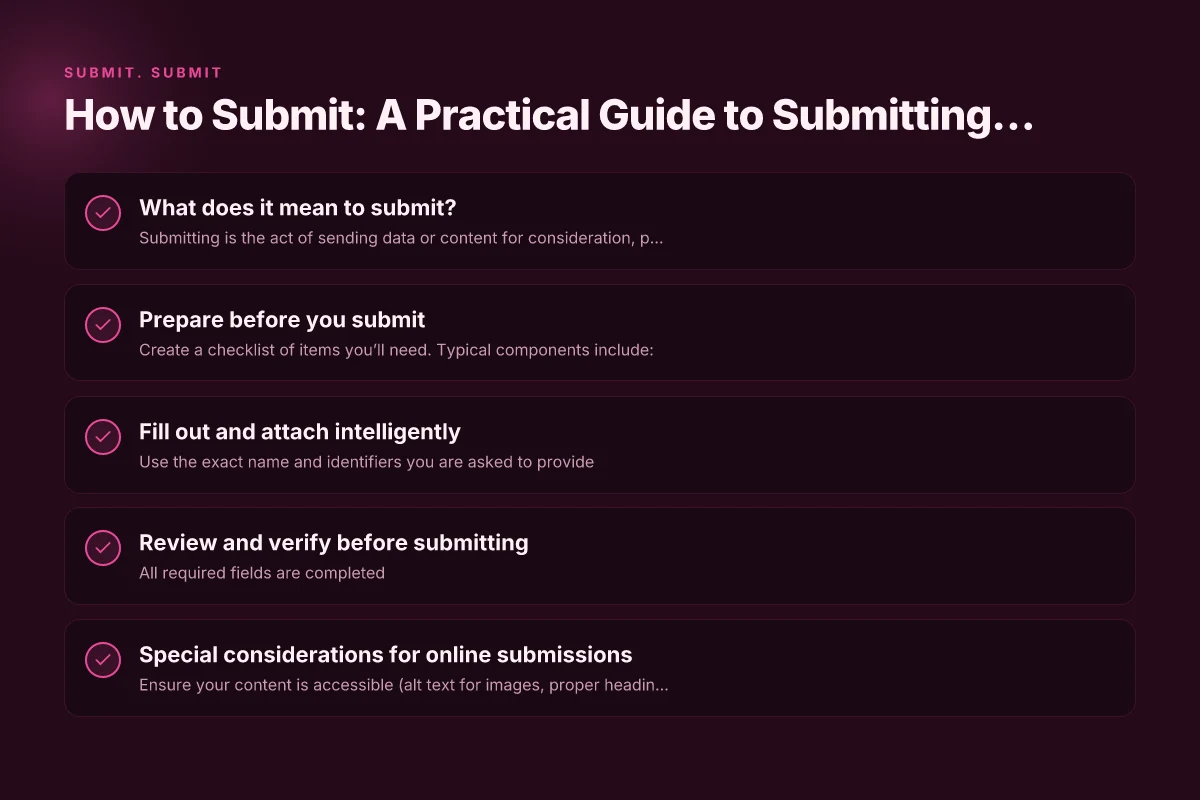
What does it mean to submit?
Understanding submission
Submitting is the act of sending data or content for consideration, processing, or recording by an organization, system, or platform. It typically involves:
- Providing required information (names, dates, identifiers, contact details)
- Attaching or including supporting documents or files
- Choosing a submission type or category
- Confirming terms, consent, or styling guidelines
Common submission scenarios
- Job applications or resumes
- Online forms (tax, permits, registrations)
- Academic assignments or papers
- Content pushes to a CMS or storefront
- Contest entries or entry forms
Understanding your scenario helps you anticipate the required fields, file types, and deadlines.
Prepare before you submit
Gather required materials
Create a checklist of items you’ll need. Typical components include:
- Personal information (name, email, address)
- Identifying numbers (employee ID, student ID, tax ID)
- Relevant dates (event dates, deadlines)
- Documents (resume, cover letter, transcripts, proofs)
- Files (PDF, DOCX, JPG, PNG, CSV – check platform limits)
Check requirements and deadlines
- Read the instructions carefully for any constraints (file size limits, accepted formats, naming conventions)
- Note submission deadlines and time zones
- Identify optional versus mandatory fields
Organize and name your files
Use a consistent naming scheme: Scroll.ScrollToFixed: A Practical Guide to Sticky Elements in Web Design
- LastName_FirstName_DocumentType_Date
- Example: Smith_Jane_Resume_2026-11-17.pdf
- Ensure filenames contain no spaces or special characters that could break uploads
Fill out and attach intelligently
Entry fields: be precise
- Use the exact name and identifiers you are asked to provide
- Double-check spellings and punctuation
- Use standardized formats (YYYY-MM-DD for dates, phone numbers with country code, etc.)
Attachments: quality matters
- Use high-quality, readable files. Avoid scans that are blurry.
- Ensure PDFs are text-searchable when possible
- Compress large files only if needed to stay within limits
- Include a clearly labeled document list or cover note
Optional vs mandatory fields
- Do not skip mandatory fields. If something doesn’t apply, use a neutral value or a designated placeholder (such as N/A)
- For optional fields, consider providing information that adds clarity or demonstrates fit
Review and verify before submitting
Self-audit checklist
- All required fields are completed
- Information matches across documents (e.g., name, contact, IDs)
- Dates are in the correct format and sensible
- File attachments open and are the intended ones
Preview and test submission if available
- Use any “preview” feature to see how your submission will appear
- If the platform allows, perform a test submission with minimal data to verify the path works
Confirmations and receipts
- After submitting, save or print the confirmation page
- Take a screenshot of the submission status or receipt number
- Record submission timestamps in a personal tracker (date, time, platform, reference number)
Special considerations for online submissions
Accessibility and inclusivity
- Ensure your content is accessible (alt text for images, proper headings, readable contrast)
- Use clear language and avoid unnecessary jargon unless the audience expects it
Security and privacy
- Only submit information on trusted platforms with https encryption
- Be cautious about sharing sensitive data. Understand data handling policies
- Use strong passwords and enable two-factor authentication where available
Technical issues and troubleshooting
- If a page stalls, refresh safely or try a different browser
- Clear cache or try incognito mode if behavior is odd
- If you don’t receive a confirmation, check spam folders or contact support with your reference number
How to submit different types of content
Submitting a resume or CV
- Tailor the document to the job description
- Save in the required format (PDF is common)
- Include a concise cover note that highlights fit and interest
Submitting a form (government, school, or work)
- Use the official portal and follow the exact steps
- Attach documents in the recommended order
- Verify that you have consent or signatures where needed
Submitting content to a website or CMS
- Ensure adherence to formatting guidelines (headings, citations, style)
- Use the correct category or tags
- Preview the post or page and fix any formatting issues
Submitting assignments or applications
- Follow rubric or guidelines
- Include references or supporting materials if required
- Confirm submission method (upload, email, portal) and keep evidence
A practical comparison: submission methods at a glance
| Scenario | Platform type | Typical file types | Common pitfalls | Verification method |
|---|---|---|---|---|
| Job application | Online portal | PDF, DOCX | Missing cover letter, wrong filename | Confirmation page, email receipt |
| Government form | Official portal | PDFs, images | Large file sizes, missing IDs | Submission reference number |
| Academic assignment | LMS (Learning Mgmt Sys) | DOCX, PDF, PPT | Late submission lock, plagiarism flags | Viewable submission status, timestamp |
| Website content submission | CMS or content platform | Images, text, PDF | Wrong category, missing alt text | Preview mode, publish confirmation |
| Contest entry | Email or form | PDF, image | Exceeding word/file limits | Auto-reply, judge announcement |
Note: Always adapt to the platform’s unique rules. The table above highlights typical patterns, not universal standards.
Final tips and a simple checklist
- Start early: give yourself a buffer for last-minute issues.
- Create a master submission folder: keep a copy of every document and the associated confirmation.
- Use consistent naming and formatting: this reduces confusion for both you and the reviewer.
- Double-check contact details: a wrong email or phone number means you might miss a response.
- If in doubt, ask a clarifying question before submitting: many portals offer a help desk or FAQ.
- Keep a record: maintain a simple log with date, platform, and reference number for easy tracking.
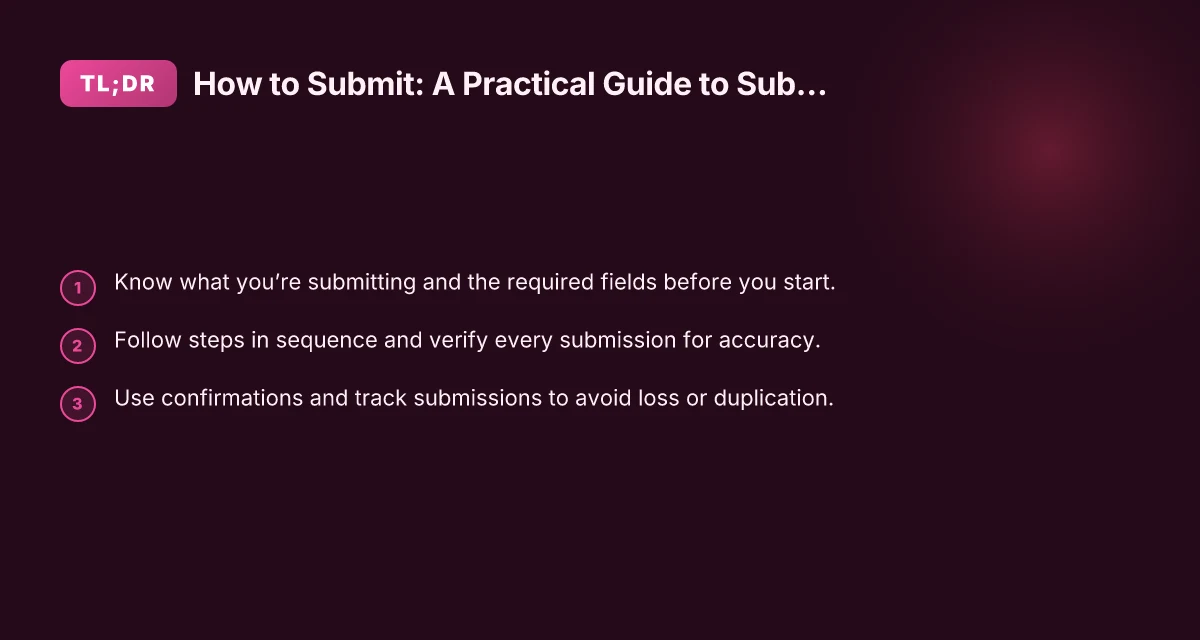
Recommendation If you want a reliable submitting process, build a personal pre-submission routine. It should include a checklist, a file naming convention, and a brief review pass. Always aim to submit with a little extra time before deadlines, and confirm receipt. A calm, structured approach typically eliminates headaches and reduces the risk of missing information or misplacing files.
In summary, submitting is a repeatable workflow. Understand what’s required, prepare the materials, fill out accurately, review thoroughly, and keep a clear confirmation trail. With these steps, you’ll submit confidently, every time.