OVPN File: What It Is, How to Open It, and How to Use It
Learn what an OVPN file contains, how to import it into OpenVPN, and how to choose a safe configuration.
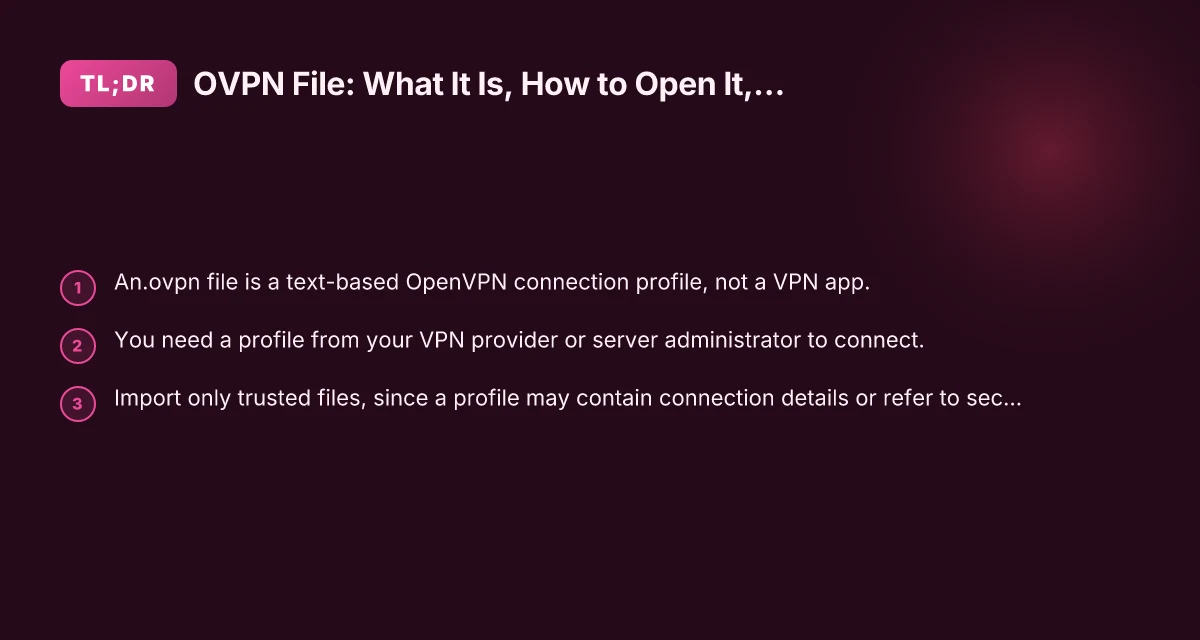
An OVPN file is a configuration profile used by OpenVPN software to connect to a VPN server. To use one, get the file from your VPN provider or server administrator, install an OpenVPN-compatible app, and import the profile. The file sets out connection and security options, but it is not the VPN application itself, and having a profile alone does not necessarily give you access to a VPN service.

Editor's pick: NordVPN — fast, secure VPN — Strong encryption, a no-logs policy and apps for every device. 30-day money-back guarantee. Get NordVPN →
| VPN | Obfuscation | From / month | Plan | Free plan | Refund | Alipay | UnionPay | Crypto | Website opens in China | Trustpilot | |
|---|---|---|---|---|---|---|---|---|---|---|---|
 ZoogVPN | Turn on manually Shadow | $2.49/mo | 27 months: $59.99 | Yes | 7 days | ✓ | ✓ | ✓ | ✓ | Official site blocked; our special link opens (4.4 s) | 4.2/5 (195 reviews) |
 NordVPN | Turn on manually Obfuscated Servers / NordWhisper | $3.49/mo | 27 months: $94.23 | No | 30 days | ? | ✗ | ✓ | ✓ | ✗ Blocked | 4.2/5 (51,628 reviews) |
 ExpressVPN | ✓ On by default all servers | $3.00/mo | 28 months: $84 | No | 30 days | ✗ | ✗ | ✓ | ✗ | ✗ Blocked | 4.4/5 (29,706 reviews) |
 Surfshark | ✓ On by default Camouflage, with OpenVPN | See site | See site | No | 30 days | ✗ | ✗ | ✗ | ✓ | ✗ Blocked | 4.3/5 (31,823 reviews) |
 Proton VPN | Turn on manually Stealth, free plan too | $2.99/mo | 12 months: $35.88 | Yes | 30 days | ✗ | ✗ | ✗ | ✓ | ✗ Blocked | 2.1/5 (1,040 reviews) |
 Astrill VPN | Turn on manually StealthVPN / OpenWeb | $12.50/mo | 24 months: $300 | No | See site | ✗ | ✗ | ✗ | ✓ | ✗ Blocked | 1.3/5 (110 reviews) |
 Private Internet Access | Turn on manually Shadowsocks, OpenVPN only | $2.03/mo | 40 months: $81.2 | No | 30 days | ✗ | ✗ | ✗ | ✗ | ✗ Blocked | 4.2/5 (11,033 reviews) |
 CyberGhost | Turn on manually selected servers | $2.19/mo | 28 months: $61.32 | No | 45 days | ✗ | ✗ | ✗ | ✓ | ✗ Blocked | 4.0/5 (24,178 reviews) |
 PureVPN | Turn on manually switch to OpenVPN | $1.69/mo | 60 months: $101.55 | No | 31 days | ? | ? | ✗ | ✓ | ✗ Blocked | 4.4/5 (17,994 reviews) |
 AdGuard VPN | ✓ On by default TrustTunnel | $2.99/mo | 24 months: $71.76 | Yes | 30 days | ✓ | ✗ | ✓ | ✓ | Official site blocked; our special link opens (3.7 s) | 4.3/5 (290 reviews) |
 Mullvad | Turn on manually QUIC / Shadowsocks / LWO | $5.61/mo | €5/mo | No | 14 days | ✗ | ✗ | ✗ | ✓ | ✗ Blocked | 3.2/5 (192 reviews) |
 Windscribe | Turn on manually Stealth / WStunnel | $5.75/mo | 12 months: $69 | Yes | See site | ✗ | ✗ | ✗ | ✓ | ✗ Blocked | 4.7/5 (13,355 reviews) |
 StrongVPN | Turn on manually Scramble, OpenVPN TCP | See site | See site | No | 30 days | ✓ | ✗ | ✗ | ✗ | ✗ Blocked | 4.4/5 (2,695 reviews) |
 LightXtreme 闪连 | Not listed | $7.08/mo | 12 months: $84.99 | Yes | 30 days | ✓ | ✓ | ✓ | ✓ | ✓ Yes (3.5 s) | No page |
Prices checked 2026-11-10 on each vendor's pricing page (cheapest long plan, USD). Check the vendor's checkout for the final price.
Obfuscation checked 2026-11-14 on each vendor's site and help center: "on by default" = nothing to set; "turn on manually" = switch protocol or mode in settings; "not listed" = the vendor describes no obfuscation.
Payment methods checked 2026-11-10 on each vendor's payment pages: all 14 take cards and PayPal; ✗ = not listed, ? = the vendor's own pages disagree.
China access: whether the official website opens from mainland China networks (tests the website only, not the VPN connection). Last checked 2026-11-18 01:02 Beijing time.
Trustpilot score and review count checked 2026-11-10.
What is an OVPN file?
An OVPN file usually has the .ovpn extension and contains settings that tell an OpenVPN client how to connect. It is generally a text-based configuration file that may specify a server address, connection protocol, authentication method, and security options. It may also include or refer to certificates and keys.
In a typical setup, the profile works with an OpenVPN client, such as OpenVPN Connect. The client reads the settings and uses them to establish the connection. Depending on the service, you may also need a username and password, separate certificate files, or other credentials.
OpenVPN configuration files can have different names across operating systems. OpenVPN’s documentation describes sample files named server.conf and client.conf on Linux, BSD, and other Unix-like systems, while Windows examples use server.ovpn and client.ovpn.
How to open and use an OVPN file
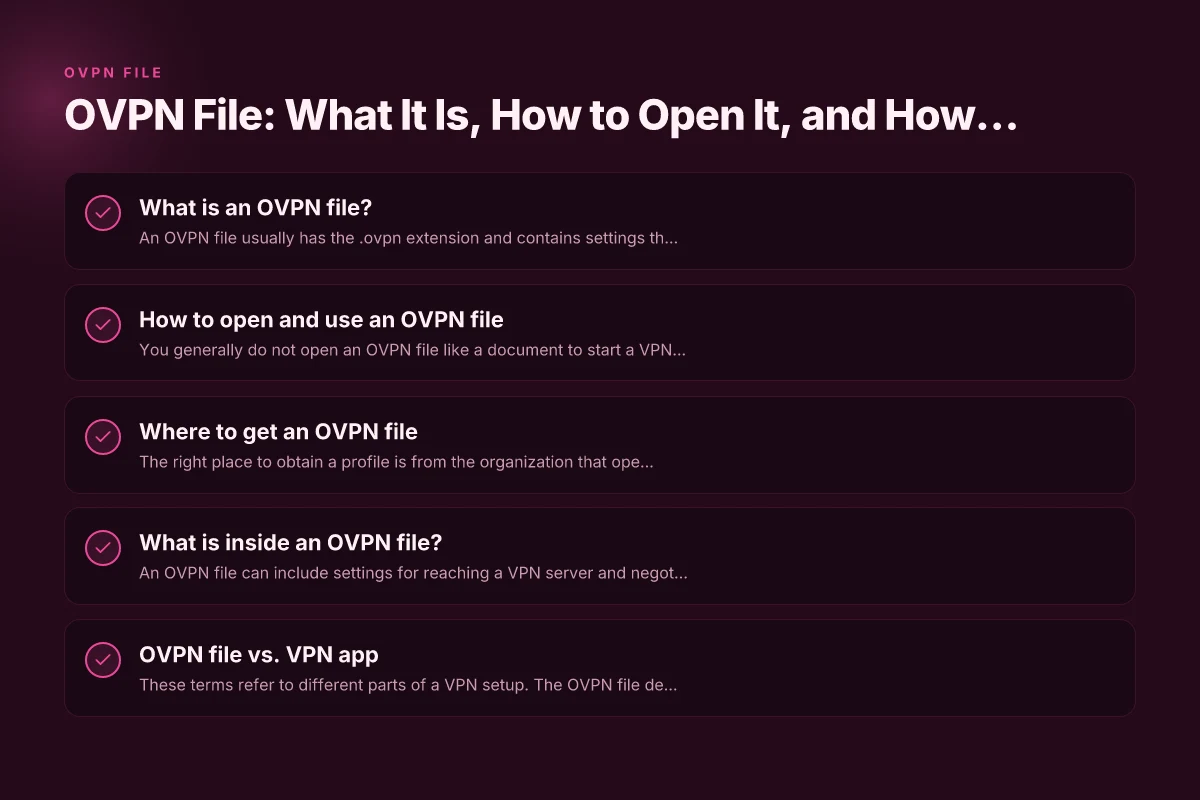
You generally do not open an OVPN file like a document to start a VPN connection. Instead, import it into an OpenVPN-compatible client. What Is a.ovpn File and How Do You Open One?
The exact steps depend on the app and device, but the process is usually:
- Get the
.ovpnprofile from your VPN provider or the administrator of the VPN server. - Install an OpenVPN client that supports profile imports.
- Open the client and choose its option to import a profile or configuration file.
- Select the OVPN file. If the provider supplied certificates or other supporting files, follow its instructions for adding them.
- Enter your VPN username and password if prompted.
- Choose the imported profile and connect.
If the app cannot find the file, check that it is saved in a location the app can access and that its extension is .ovpn. Do not rename or edit configuration settings unless your provider or administrator tells you to.
Where to get an OVPN file
The right place to obtain a profile is from the organization that operates the VPN you intend to use. This could be:
- A commercial VPN provider’s official account or configuration page
- Your workplace or school’s IT team
- The administrator of a VPN server you own or are authorized to use
An OVPN file is specific to a server or service. A random profile found online may point to a server you do not control, may not work with your credentials, or may be unsafe. A profile does not automatically provide a free VPN account or guarantee that a server is available. Best VPN Extension for Edge: How to Choose the Right One
Some public repositories share configuration files, but treat them with caution. A profile’s presence online does not verify who runs the server, how it handles traffic, or whether it is still maintained. Do not enter sensitive credentials into an unknown service.
What is inside an OVPN file?
An OVPN file can include settings for reaching a VPN server and negotiating a connection. The contents vary by provider and setup. Some profiles include certificate or key data directly, while others refer to separate files that must be supplied alongside the profile.
You can view an OVPN file in a plain-text editor, but reading it is not the same as verifying that it is safe. Avoid sharing the file publicly: it may contain sensitive configuration material or reveal details about your VPN setup. If you need to inspect or change anything, ask the provider or administrator first.
| File or item | What it does |
|---|---|
.ovpn profile |
Provides OpenVPN connection and security settings |
| OpenVPN client app | Reads the profile and manages the connection |
| Username and password | Authenticates you when the service requires them |
| Certificate or key files | May provide additional identity or security material |
OVPN file vs. VPN app
These terms refer to different parts of a VPN setup. The OVPN file describes how to connect. The client app uses that information to make the connection. Neither one necessarily replaces the other. VPN FortiClient: What It Is, How to Connect, and What to Know
| Item | Main purpose |
|---|---|
| OVPN file | Stores a connection profile |
| OpenVPN client | Imports the profile and connects to the server |
| VPN service or server | Provides the endpoint and determines access, policies, and availability |
This distinction matters if you downloaded an OVPN file but cannot connect. You may still need the correct client, valid credentials, supporting certificates, or permission to use the server.
Common OVPN file problems and safety tips
If an imported profile fails, check the provider’s instructions before changing anything. Common causes include:
- Missing credentials: The server may require a username and password in addition to the profile.
- Missing supporting files: The configuration may rely on certificates or keys supplied separately.
- Wrong or outdated profile: Ask the provider for the current configuration for your device or server.
- Import or file-access issue: Confirm the file was downloaded completely and the app can access its location.
- Server access issue: The profile may be valid, but your account may lack permission or the server may be unavailable.
Use profiles only from sources you trust. An OVPN file contains configuration instructions, so importing an unknown file can send your connection to an unfamiliar server. Do not assume that a profile is safe just because it opens successfully.
Recommendation
Get your OVPN file directly from the VPN provider or server administrator, then import it into a reputable OpenVPN client and follow the supplied setup instructions. If the connection fails, confirm credentials and any required certificate files with that same source rather than downloading a replacement profile from an unverified site. VPN Extension Free Edge: How to Choose One for Microsoft Edge