PostFixed.ScrollToFixed: A Practical Guide to Sticky Elements and Smooth Scrolling

Learn how to implement postFixed.ScrollToFixed for reliable sticky elements and smooth scrolling behavior across browsers.
Sticky UI components are a common feature in modern web interfaces. When you need an element to stay visible on the screen as the user scrolls, postFixed.ScrollToFixed offers a reliable approach to managing that behavior. In this guide, we’ll cover what postFixed.ScrollToFixed is, how it works, common use cases, and practical implementation tips.

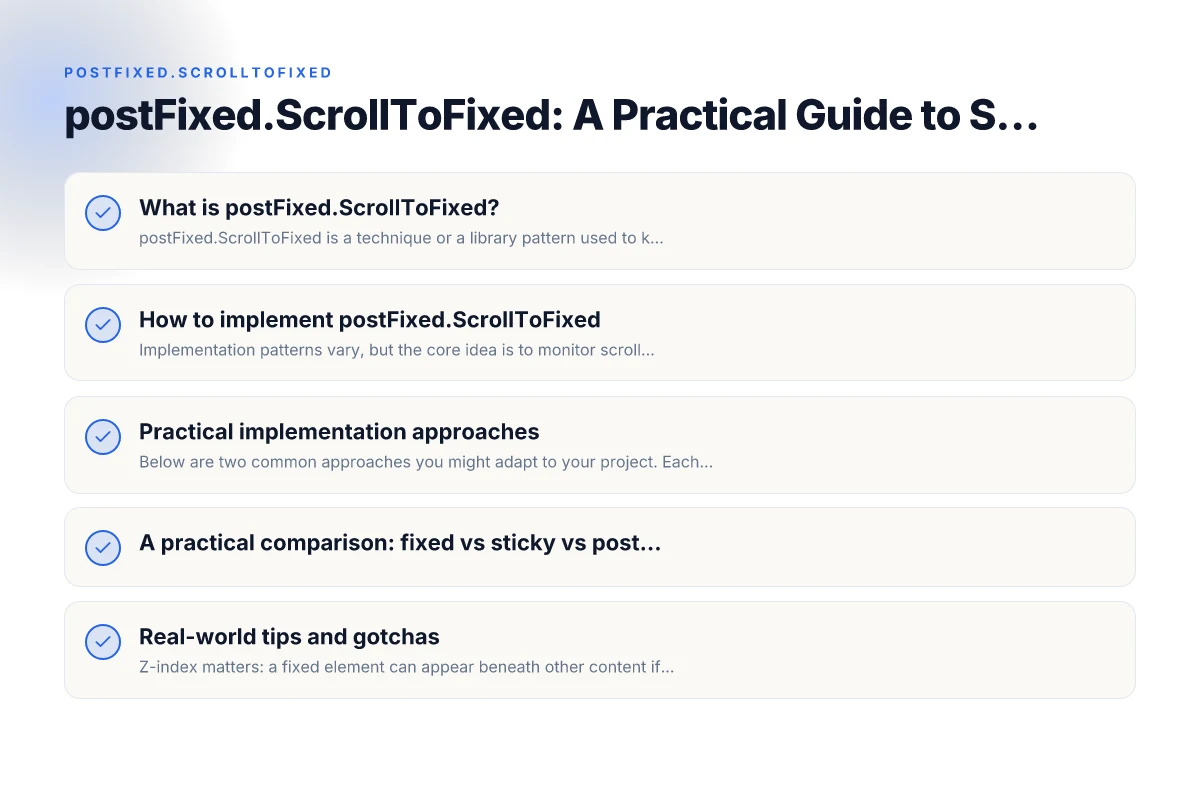
What is postFixed.ScrollToFixed?
postFixed.ScrollToFixed is a technique or a library pattern used to keep an element fixed within the viewport as the user scrolls. It aims to solve the quirks of pure CSS position: fixed in complex layouts, or to provide a more robust solution when browser support or layout changes require additional handling. The idea is to attach behavior to an element so that it remains visible in a controlled way, even as its surrounding content moves.
Why use postFixed.ScrollToFixed?
- Consistent sticky behavior across sections of a page.
- Compatibility across browsers with nuanced support for fixed positioning.
- More control over when and how the element becomes fixed (thresholds, offsets, etc.).
- Ability to coordinate multiple sticky elements without layout thrashing.
Common patterns you’ll encounter
- Sticky headers that stay at the top after scrolling past a hero section.
- Floating action buttons that remain visible as content changes.
- Sidebars that fix into view when they reach a certain scroll position.
How to implement postFixed.ScrollToFixed
Implementation patterns vary, but the core idea is to monitor scroll position and toggle a fixed state on the target element. Here are practical steps and considerations:
Basic setup
- Select the element you want to fix.
- Determine the offset from the top (or left/right) to start fixing.
- Add or remove a fixed class or inline styles to switch between normal and fixed positioning.
Handling offsets and thresholds
- You may want a topOffset to account for a fixed header.
- Use a threshold where the element becomes fixed only after the user has scrolled past a certain point.
- Consider reverse behavior: unfix the element when scrolling back above the threshold.
Debounce and performance
- Debouncing scroll handlers can improve performance on slower devices.
- Use requestAnimationFrame for smoother updates in high-signal scenarios.
- Avoid layout thrashing by reading layout properties (like offsetTop) sparingly.
Responsive considerations
- Offsets may need to adapt to viewport size. Listen for resize events.
- Fixed positioning can interact with transforms in the parent layout. Test in multiple breakpoints.
- Ensure touch and accessibility remain intact when the element becomes fixed.
Practical implementation approaches
Below are two common approaches you might adapt to your project. Each offers a balance of simplicity and control.
Pure JavaScript approach
- Track the element’s original offsetTop.
- On scroll, compare window.pageYOffset to offsetTop minus topOffset.
- Toggle a CSS class that applies position: fixed and top: topOffset.
- Restore to normal flow when scrolling back above the threshold.
Pros: PostAbsolute.ScrollToFixed: A Practical Guide to Fixed Positioning After Scroll in Web UIs
- Simple to reason about.
- No dependencies.
Cons:
- Requires careful layout management to avoid content jumps.
JQuery-like approach (less common today)
- Use a plugin-like pattern to attach behavior to the element.
- Provide options for topOffset, zIndex, and stability when multiple sticky elements exist.
- Manage state via classes and data attributes.
Pros:
- Familiar for teams using jQuery-style patterns.
Cons:
- Larger footprint and less modern.
A practical comparison: fixed vs sticky vs postFixed.ScrollToFixed
| Approach | Pros | Cons | Best Use Cases |
|---|---|---|---|
| CSS position: sticky | Simple, native, zero JS | Limited browser support for older versions; needs proper layout context | Headers or sidebars in modern browsers |
| CSS position: fixed | Always visible, simple in isolation | Can overlap content; tricky in dynamic layouts | Floating buttons; always-visible controls |
| postFixed.ScrollToFixed (JS pattern) | High control; works with complex layouts; adjustable thresholds | More code; needs careful maintenance | Complex pages with dynamic sections; multiple sticky elements |
Real-world tips and gotchas
- Z-index matters: a fixed element can appear beneath other content if z-index isn’t set high enough.
- Space in the document flow: when an element becomes fixed, the document’s normal flow changes. You may need a placeholder element to prevent layout shifts.
- Accessibility: ensure screen readers and keyboard users can still navigate. If the fixed element is interactive, ensure focus management remains logical.
- Performance: throttle or debounce scroll events to reduce reflows, and prefer requestAnimationFrame for updates.
- Testing: test across devices, especially on older iOS versions where fixed positioning behaves differently.
Example: a simple fixed header that appears after scrolling past a hero
- HTML:
- A header element you want to fix.
- A hero section with the top content that should scroll away naturally.
- CSS: -.header { position: relative. Transition: top 0.2s; } -.header.fixed { position: fixed. Top: 0. Left: 0. Right: 0. Z-index: 1000; }
- JavaScript (conceptual):
- const header = document.querySelector('.header');
- const heroBottom = document.querySelector('.hero').offsetTop + document.querySelector('.hero').offsetHeight;
- window.addEventListener('scroll', () => { if (window.pageYOffset > heroBottom) header.classList.add('fixed'); else header.classList.remove('fixed'); }); This is a straightforward representation of the postFixed.ScrollToFixed concept: the header becomes fixed only after the user scrolls past the hero section, then it stays fixed as the rest of the content scrolls.
Testing and debugging tips
- Check on multiple browsers and devices. Some older browsers handle fixed positioning differently.
- Validate layout integrity when the element becomes fixed: do you need to reserve space to prevent content jump?
- Ensure that focus outlines remain visible for interactive fixed elements to aid keyboard navigation.
- Use visual debugging aids (temporary borders or outlines) to verify when the element is in fixed mode.
When to choose postFixed.ScrollToFixed over other options
- You have a complex layout where a simple sticky header would collide with other fixed or transformed elements.
- You need precise control over when the element becomes fixed, and you want to manage multiple sticky regions in relation to each other.
- You’re targeting legacy browsers that require a JavaScript-driven approach to achieve consistent behavior.
Final recommendation
If your page relies on a traditional, straightforward sticky effect, CSS position: sticky or a simple fixed element with a top offset may suffice. However, when your layout includes dynamic sections, overlapping content, or multiple sticky elements that must react to scrolling in coordinated ways, a postFixed.ScrollToFixed approach, or a custom JavaScript solution that mimics its behavior, offers the most reliability and control. Start with a minimal, well-documented implementation, measure performance, and iterate with accessibility and responsive design in mind. Microsoft.XMLHTTP: Understanding its purposes, usage, and modern alternatives